
Other names: none
Abundance: common
What: ripe berries (black)
How: cooked, wine
When: late summer, fall
Where: woods, borders
Nutritional Value: low in carbohydrates, minerals and vitamins
Dangers: Berries contain crystals of calcium oxalate which must be removed before consuming.
On this page: Identification · Range & Ecosystem · Uses · Dangers · Harvest Time · Possible Mimics
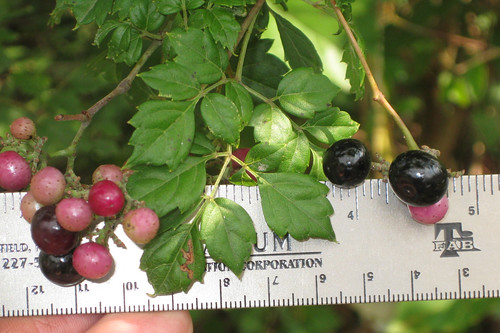 |
| Ripe (black) and unripe (pink-purple) peppervine berries and compound leaves |
Peppervine is a summertime vine that loves hot weather though the berries don't appear until close to the start of the school year. These vines prefer full sun to partial shade so look for them along fences in your neighborhood and climbing over bushes at the edges of woods. Soil type doesn't seem to matter.
Identification
Identification Features
- Leaf Arrangement: The leaves of Ampelopsis arborea are arranged alternately along the stem.
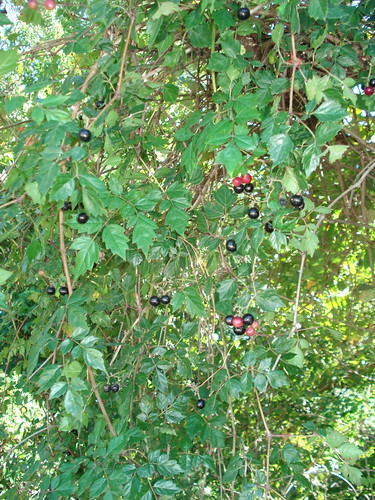
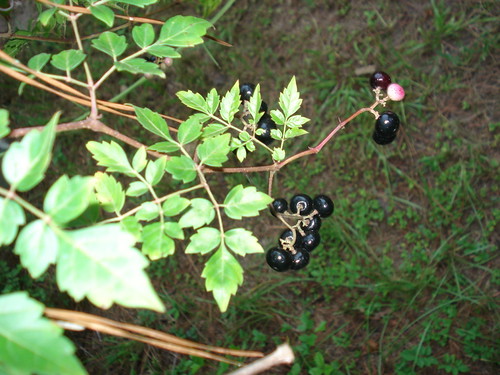
- Leaf Shape: Leaves are typically compound with 3-5 leaflets with each lobe being ovate to elliptical. Entire leaf may be approximately 3 to 5 inches in length, with each leaflet being about 1/2" across.
- Leaf Venation: Pinnate venation, with veins running from the base to the valley of each leaflet serration.
- Leaf Margin: The leaf margin is typically serrated or toothed.
- Leaf Color: The leaves are green.
- Flower Structure: Peppervine produces small, inconspicuous flowers that are arranged in clusters.
- Flower Color: Flowers are typically greenish-white or yellowish-green.
- Fruit: The fruit is a small, spherical berry-like structure with a diameter of approximately 1/4 to 1/2 inch. The berries start out white/yellowish, turning to pink with red/purple spots, and then finally turning dark purple/black when ripe.
- Seed: Inside the fruit are small seeds.
- Stem: The stem is typically climbing or trailing, often with tendrils for support.
- Hairs: Fine hairs may be present on the leaves.
- Height: Peppervine is a climbing vine and can reach varying heights depending on its support structure.
 |
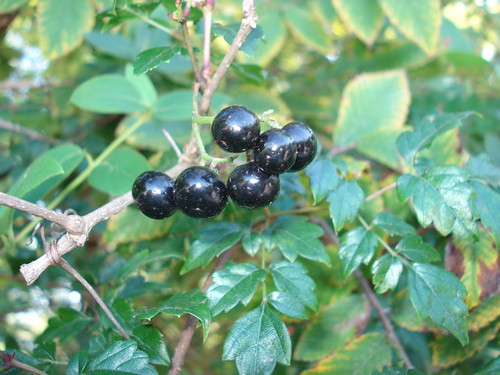 |
| Ripe peppervine berries |
 |
Range & Ecosystem
Range
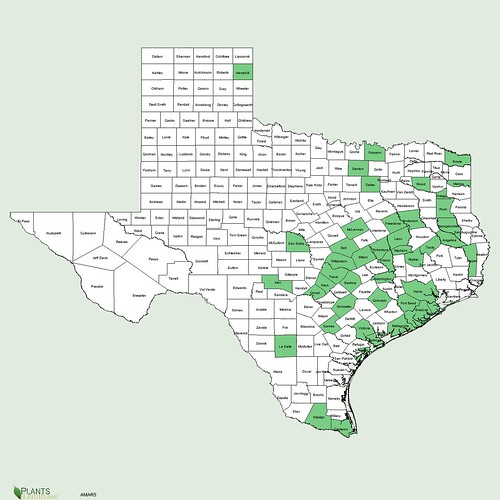 |
| Texas distribution, attributed to U. S. Department of Agriculture. The marked counties are guidelines only. Plants may appear in other counties, especially if used in landscaping. |
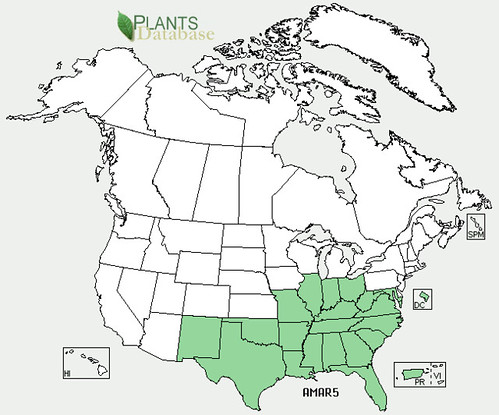 |
| North American distribution, attributed to U. S. Department of Agriculture. |
Ecosystem
woods, borders
Uses
Food
What: ripe berries (black)
How: cooked, wine
Nutritional Value: low in carbohydrates, minerals and vitamins
The sweet, grape-flavored berries are ripe when they are black. Leave the spotted pink and purple berries to ripen more.
Luckily, calcium oxalate isn't very water soluble and is easy to separate from the berries' juice. My preferred method is to squeeze the berries through cheesecloth, collecting the juice and discarding any solids left in the cheesecloth. Now add one ounce of tap water to every nine ounces of juice and place this solution in a see-through pitcher or bottle in your refrigerator. Let it sit overnight which causes the needles of calcium oxalate to settle down to the bottom of the container. Carefully pour off the liquid while avoiding stirring up and re-adding the calcium oxalate back into the solution. Pouring it through a coffee filter will help remove the crystals. It's best to err on the side of caution and leave behind juice rather than get some of the calcium oxalate.
Once you've filtered out the calcium oxalate you can use this juice like grape juice. Drink it, jelly/jam it, or even make wine from it!
Medicine
Harvesting Tips
Dangers
Though delicious, most people get a weird tickle in the back of their throat after eating one or more berries. This tickle is actually due to tiny needles of calcium oxalate which are a defensive measure of the Peppervine. Excessive consumption of calcium oxalate will result in chemical burns in your throat.
Harvest Time
When: late summer, fall
Possible Mimics
Learn this plant in person: Upcoming classes
