
Other names: none
Abundance:
What: fruit
How: raw, jelly
When: fall
Where: landscaping, Gulf Coast region
Nutritional Value:
Dangers:
On this page: Identification · Range & Ecosystem · Uses · Dangers · Harvest Time · Possible Mimics
 |
| Queen palm. |
Standing majestically, Queen palms live up to their names and so are often used as a landscaping palm. If you want to add one to your yard they prefer acidic, moist soil and are somewhat salt-tolerant if you are near the coast.
Identification
Identification Features
- Leaf Arrangement:
- Leaf Shape: Queen palm crown. Needle-type leaves. Its leaves can be up to fifteen feet in length. The individual fronds are somewhat stiff.
- Leaf Venation:
- Leaf Margin:
- Leaf Color:
- Flower Structure:
- Flower Color:
- Fruit: The orange fruit appear in late summer/early fall. In the late summer/fall appear large clusters up to six feet long of orange, one inch fruit. The flesh of this fruit is sweet but fibrous. Close-up of the fruit. You can see the fibrous nature in the older, brown/gray fruit.
- Seed:
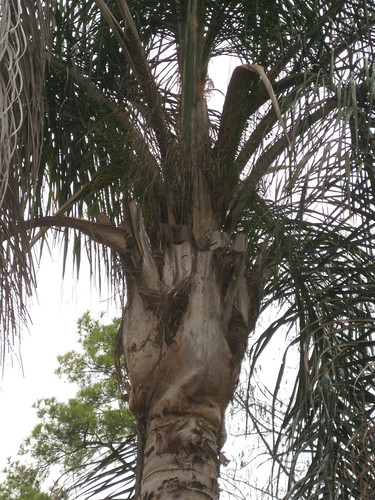
- Stem: Their trunk is rather smooth and gray.
- Hairs:
- Height:
 |
 |
| Queen palm base. |
 |
| Queen palm trunk. |
 |
 |
| Queen palm crown. Needle-type leaves. |
 |
| The orange fruit appear in late summer/early fall. |
 |
| Close-up of the fruit. You can see the fibrous nature in the older, brown/gray fruit. |
Range & Ecosystem
Range
Ecosystem
landscaping, Gulf Coast region
Uses
Food
What: fruit
How: raw, jelly
Nutritional Value:
In the late summer/fall appear large clusters up to six feet long of orange, one inch fruit. The flesh of this fruit is sweet but fibrous. Just chew/suck the sweetness from the fruit and then spit out the fibers. Like the Pindo palm, these sweet fruit can also be used to make jelly or wine. A good quality palm nut oil can be extracted from the seeds though some sort of oil press is recommended for this.
Medicine
Harvesting Tips
The fruit is often 20 or more feet off the ground which makes harvesting tricky. Lay a tarp down beneath the tree and then either shake the tree (difficult) or toss a Nerf ball at the clusters to dislodge the fruit. A Nerf ball is hard enough to dislodge the fruit but soft enough to not damage them.
Dangers
Harvest Time
When: fall
Possible Mimics
Learn this plant in person: Upcoming classes
