
Other names: none
Abundance: common
What: leaves, flowers
How: tea, seasoning
Medicinal parts: Leaves/Flowers
When: all year
Where: dry sunny yards, landscaping
Nutritional Value: flavonoids
Dangers:
On this page: Identification · Range & Ecosystem · Uses · Dangers · Harvest Time · Possible Mimics
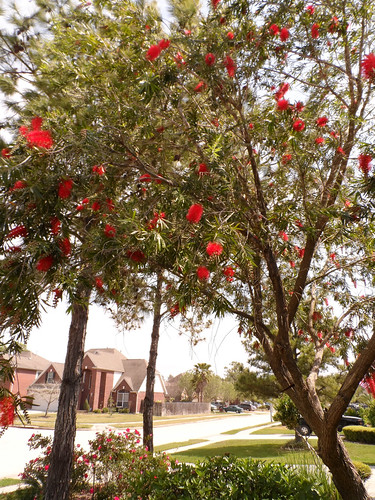 |
| Bottlebrush tree |
Used often as a decorative landscaping tree, the striking red blossoms of the bottlebrush tree offer more than visual beauty. Their aroma is invigorating, somewhat minty or menthol in nature. The trees are small, rarely more than 15' tall and equally as wide. The leaves are evergreen and the blossoms also last and can be found on the tree almost all year round. These flowers really explode vigorously in mid-spring and are often swarmed with bees who know a good thing when they smell it!
Identification
Identification Features
- Leaf Arrangement: The leaves are typically arranged alternately along the branches.
- Leaf Shape: Leaves are lance-shaped, measuring around 2 to 6 inches in length.
- Leaf Venation: The leaves have a prominent midrib with lateral veins.
- Leaf Margin: Leaf margins are generally smooth, without serrations.
- Leaf Color: Dark green on top and underside
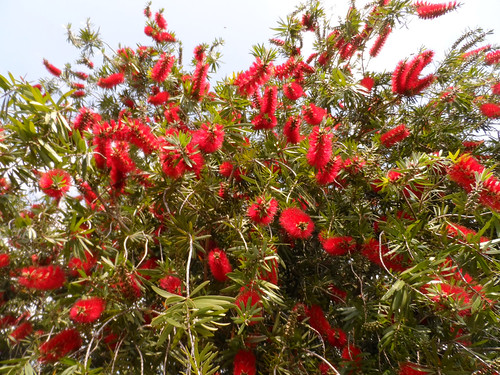
- Flower Structure: The distinctive feature of the bottlebrush tree is its cylindrical flower spikes resembling a bottlebrush. The spikes can range from 2 to 12 inches in length.
- Flower Color: Flowers come in various colors, including red, pink, purple, yellow, or white, depending on the species or cultivar.
- Fruit: The fruit is a small, woody capsule containing the seeds. Colors can range from brown to gray.
- Seed: The seeds are small and enclosed in woody capsules within the spent flower spikes.
- Bark: The bark is typically smooth and ranges in color from gray to brown.
- Hairs: Leaves and stems may have fine hairs, particularly when young.
- Height: Bottlebrush trees can vary in height, with some species growing up to 10 to 15 feet, while others can reach up to 30 feet.
 |
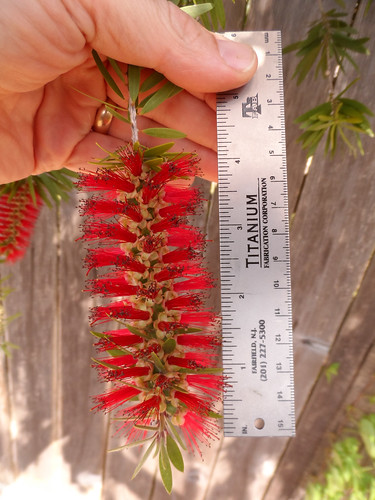 |
| Close-up of opened flowers. |
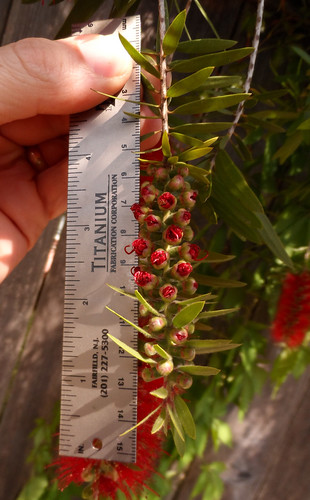 |
| Close-up of closed flowers. |
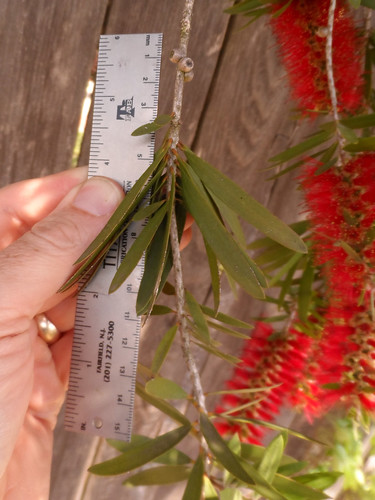 |
| Close-up of leaves. |
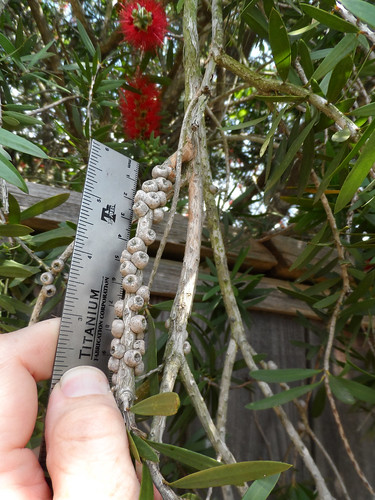 |
| Close-up of branch with woody fruit. |
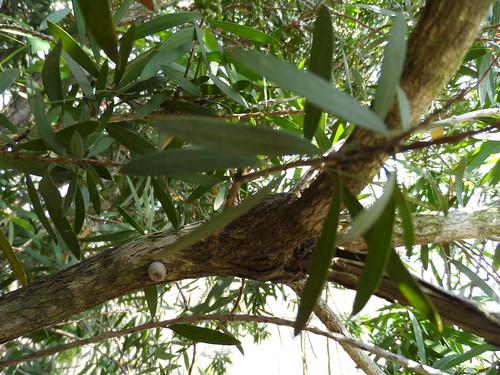 |
| Bottlebrush branch. |
Range & Ecosystem
Range
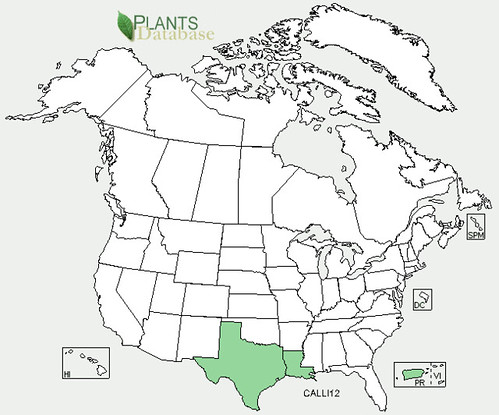 |
| North American distribution, attributed to U. S. Department of Agriculture. |
Ecosystem
dry sunny yards, landscaping
Uses
Food
What: leaves, flowers
How: tea, seasoning
Nutritional Value: flavonoids
Both the flowers and leaves can be used to make an aromatic tea. The fresh blossoms do give a sweeter flavor than leaves. Aging the harvested leaves for two weeks helps as this breaks down the cell walls, allowing more of the flavorful compounds to escape into the tea. Flowers, being more delicate, do not benefit any from being aged and ideally are used fresh off the tree.
You can also use the leaves and flowers of the bottlebrush tree similar in manner to bay or rosemary leaves. Add several to a sauce, stew, or roasting meat to add an exotic flavor.
Mashed bottlebrush leaves rubbed on the skin are reported to keep away insects. This property may also be used to keep clothes, bedding, and houses bug free by laying sprigs of the leaves around whatever you want protected.
Medicine
Medicinal Summary:
Leaves/Flowers - antifungal; antibacterial; antioxidant; cough suppressant (tisane)
Harvesting Tips
Dangers
Harvest Time
When: all year
Possible Mimics
Learn this plant in person: Upcoming classes
