Showing posts sorted by relevance for query vine. Sort by date Show all posts

Balloon Vine

Scientific Name(s): Cardiospermum corindum
Abundance: invasive
What: young leaves; vine tips
How: cooked
Where: fields, borders, dry, moist
When: spring, summer, fall, winter
Nutritional Value: minor
Dangers: none

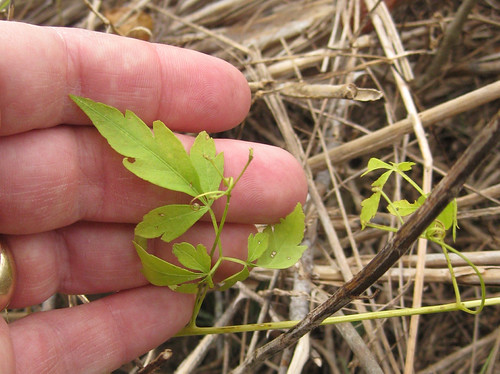
Leaf Arrangement: The leaves of Cardiospermum corindum are arranged alternately along the stem.

Leaf Shape: Leaves are compound, usually with three leaflets, each leaflet being broadly ovate to heart-shaped, measuring approximately 1 to 3 inches in width.

Leaf Venation: Pinnate venation, with veins running from the base to the tip of each leaflet.

Leaf Margin: The leaf margin is typically serrated or toothed.

Leaf Color: The leaves are green.

Flower Structure: The flowers are approximately 1/4" across, with four petals, and occur in clusters.

Flower Color: Flowers are typically greenish-white.

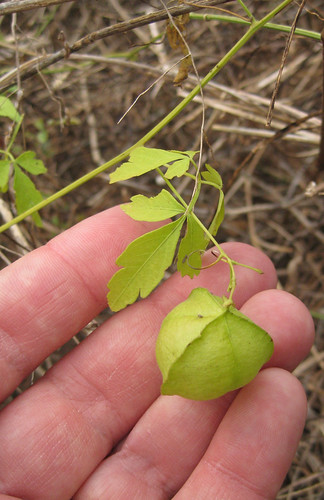
Fruit: The fruit is a distinctive, papery capsule with three inflated chambers, resembling balloons.

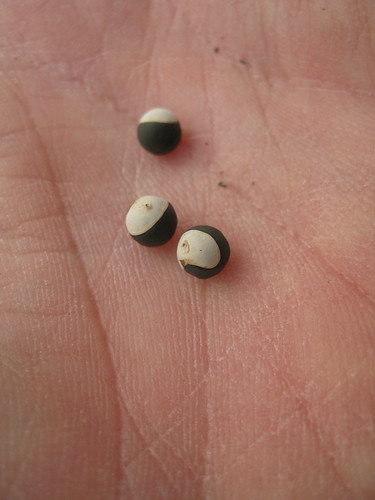
Seed: Inside each inflated capsule are small, black seeds with a white band running partway around the seed. 

Stem: The stem is typically climbing or trailing, and it may have fine hairs.

Hairs: Appears hairless or extremely fine hairs.

Height: Cardiospermum corindum can climb to significant heights but is often seen trailing along the ground or climbing on other vegetation.


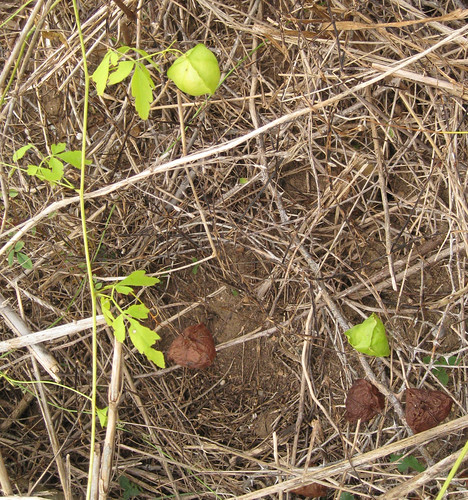
Ballon vine plant in the fall.
BalloonVine2

Balloon Vine flower. They can keep producing flowers while the temperatures are still warm.
BalloonVine

Balloon vine leaf.
BalloonVineLeaf

Balloon vine leaf and green seed pod "balloon". Seed pod/seeds are NOT edible.
BalloonFlowerPod1

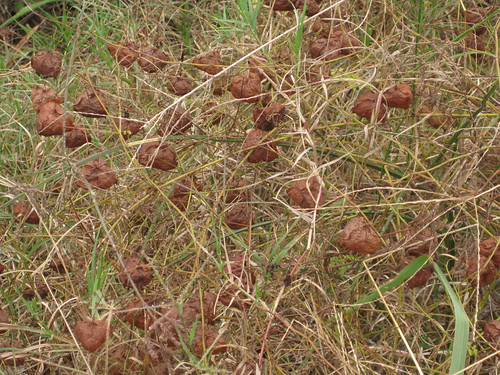
Dried balloon vines seed pods.
DriedBalloonVine

Balloon vine seeds.
BalloonVineSeeds

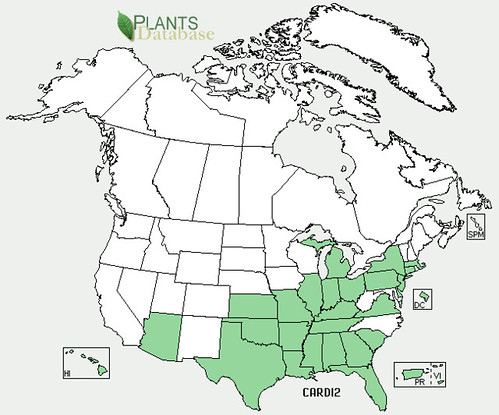
North American distribution, attributed to U. S. Department of Agriculture.
BalloonVine

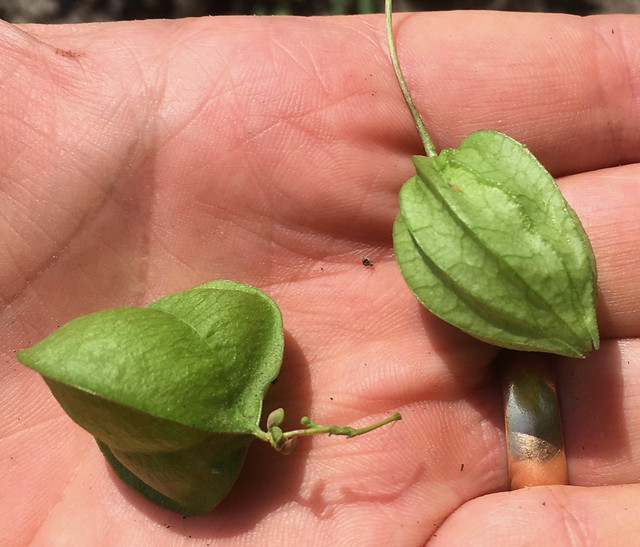
Balloon Vine on the left, Ground Cherry on the right.
BalloonVine-GroundCherry

Across fields and disturbed areas of Texas and the South, Balloon Vines are taking hold. Keep an eye out in sunny fields, especially along ditches and other areas where water may collect. Balloon vines are easily spotted by their small, puffy, pointed seed pods. These pods are mostly air with the fruit located in the center. If the weather stays warm these vines can produce these balloon-like seed pods all year long so you may see white flowers, young, green pods, and dried, brown pods all on the same vine.

Balloon vines are an invasive species from Asia and can quickly cover and kill native plants. This makes a good argument for eating them! The edible parts are its young leaves and vine tips. These are cooked before eating, though to be honest I don't know why. That's how they do it in Asian countries, which is a good enough reason for me.

The puffy seed pods are not eaten, nor are the seeds contained in these "balloons". However, both the leaves and seeds were used medically in India and Asia, along with the roots. Leaf poultices were used on skin wounds and infections as well as minor muscle and joint problems like strains, sprains and arthritis. Tea made from the leaves was traditionally used against stress and bronchitis. Tea from the root was applied topically to treat hemorrhoids. The seeds were crushed for a tea given to relieve fevers and joint pain.


Buy my book! Outdoor Adventure Guides Foraging covers 70 of North America's tastiest and easy to find wild edibles shown with the same big pictures as here on the Foraging Texas website.

Passion Vine/Maypop

Scientific name: Passiflora incarnata
Abundance: common
What: flowers, ripe fruit, juice, leaves
How: raw, preserves, cold drink, tea
Where: sunny fields, yards, borders
When: late summer through fall until frost
Nutritional Value: Vitamin A & niacin

Medicinal Summary:
Leaves - sedative (tisane)
Flowers - anti-anxiety (tisane)

Leaf Arrangement: The leaves of Passiflora incarnata are arranged alternately along the stem.

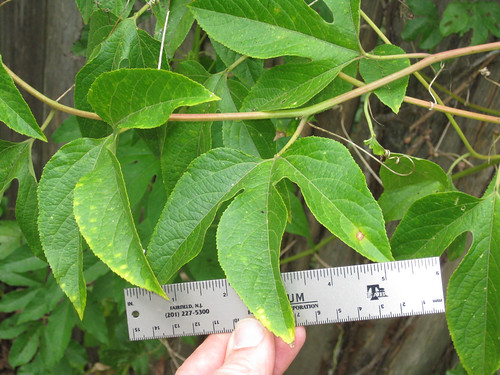
Leaf Shape: Leaves are typically palmately lobed and palmately veined, with usually three to five lobes, each lobe being ovate to triangular, measuring approximately 3 to 6 inches in width.

Leaf Venation:
 Palmate venation, with prominent veins running from the base to the tip of each lobe.

Leaf Margin: The leaf margin is typically serrated or toothed.

Leaf Color: The leaves are usually medium green.

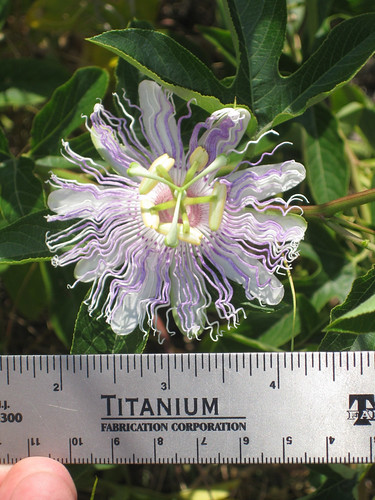
Flower Structure: Purple Passionflower produces intricate and showy flowers with a unique structure. They have five petal-like sepals, five petal-like corolla segments, and a central crown of filaments and anthers. The flowers can be up to 3 inches in diameter.

Flower Color: Flowers are typically violet-purple and have white or pinkish-purple filaments.

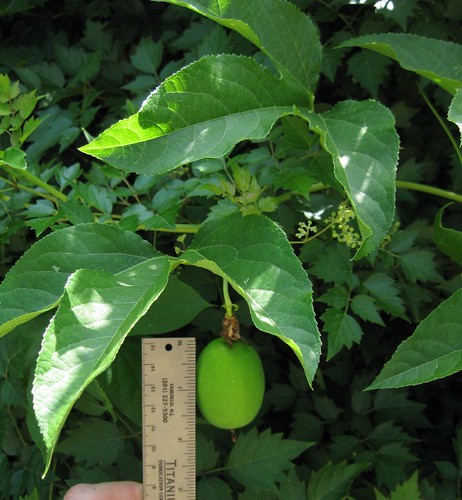
Fruit: The fruit is an ovoid to globose berry approximately 2" in diameter with a tough outer rind. Rind is green when young then turns yellow as it ripens.

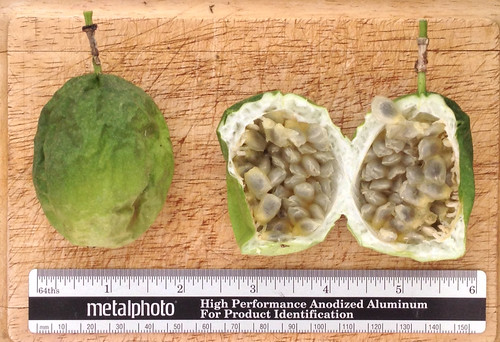
Seed: Inside the fruit are numerous small seeds suspended in clear gel.

Stem: The stem is typically a climbing vine with tendrils for support.

Hairs: Fine hairs may be present on the stem.

Height: Passiflora incarnata can climb on other vegetation and reach varying heights.


Passion vine flower
PassionvineFlower

Unripe passionvine fruit (maypop)
PassionVine3

Inside of a passionvine fruit (maypop).
Maypop Passionvine

Three-lobbed passion vine leaves
PassionVine1

Closeup of the passion vine leaf.
PassionvineLeaves

Texas distribution, attributed to U. S. Department of Agriculture. The marked counties are guidelines only. Plants may appear in other counties, especially if used in landscaping.
Passionvine

North American distribution, attributed to U. S. Department of Agriculture.
Passionvine

The maypop fruit is ripe when it turns from "Kermit the Frog" green to light green to yellow-orange in color. A better indication of a ripe maypop is a somewhat wrinkly skin whereas the unripe maypop fruit will have a firm, tight feel. Upon splitting the fruit you will see numerous seeds coated in a translucent goo while the inside of the skin will have a thick layer of white pulp. Suck the goo off the seeds like you were eating a pomegranate. The white pulp inside the skin is scrapped off with a spoon and eaten. Roasted seeds of these maypops are considered to be a wonderful snack in Puerto Rico.

Wild passion vines are uncommon in Texas so refrain from harvesting many the low-nutritional value fruit unless you find a vine really covered in fruit. These vines seem to produce a lot of fruit the year after a drought.

Tea made from the dried leaves and stem of the passionvine contain alkaloids with a sedative effect on humans. This tea can be purchased over the counter as a "sleepy time" the United States. Passionvines can quickly grow to cover a large area so harvesting young leaves and stems for use in tea will help keep the vine in check. As with any medicinal tea, I don't recommend drinking it more than 2-3 cups per week. They flowers can also be used for tea but they lack the sedative effect and you also lose the fruit from that flower.


Buy my book! Outdoor Adventure Guides Foraging covers 70 of North America's tastiest and easy to find wild edibles shown with the same big pictures as here on the Foraging Texas website.

Kudzu

Scientific name: Pueraria species (P. lobata, P. montana, P. edulis, P. phaseoloides and P. thomsoni)
Abundance: plentiful
What: young vine tips, young leaves, flowers, roots
How: vine tips & leaves cooked; flowers raw or tea; roots scraped for starch
Where: fields, old farms,
When: spring, summer, fall, winter
Nutritional Value: vitamins, antioxidants, protein, calories
Other Uses: kudzu vines can be woven into fine baskets
Dangers: do NOT plant kudzu, it'll engulf everything!! Be very careful transporting kudzu so as not to drop any seeds.

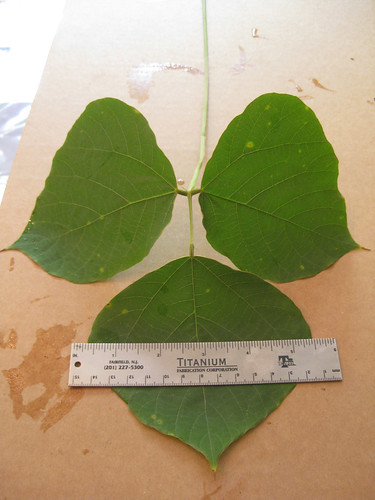
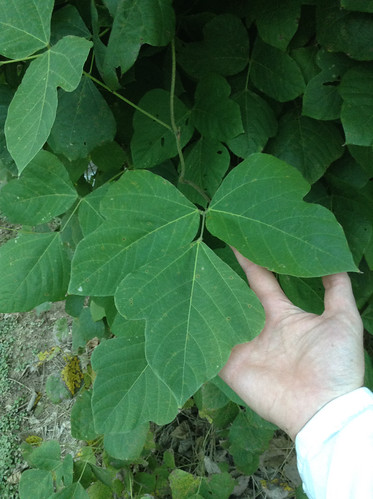
Leaf Arrangement: The leaves of Kudzu are compound and arranged alternately along the stem.

Leaf Shape: Leaflets are typically palmately trifoliate, each leaflet being ovate to elliptical, measuring approximately 3 to 5 inches across.

Leaf Venation: Pinnate venation, with veins running from the base to the tip of each leaflet.

Leaf Margin: The leaf margin is typically entire or slightly toothed.

Leaf Color: The leaves are usually medium to dark green on top and can be lighter in color underneath.

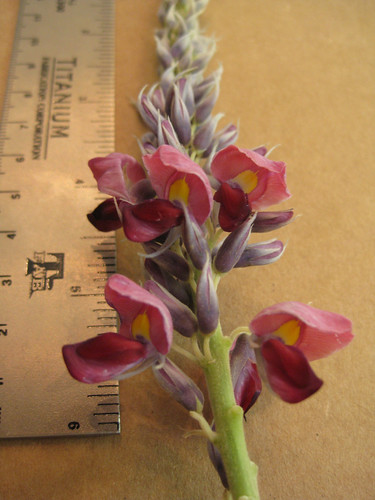
Flower Structure: Kudzu produces clusters of small, pea-like flowers arranged in elongated, drooping inflorescences. The flowers have a length of approximately 1/2 to 3/4 inch.

Flower Color: Flowers are typically purplish-pink to reddish-purple.

Fruit: The fruit is a small, flat, and brown pea-like pod containing seeds. The pods have a length of approximately 2 to 4 inches.

Seed: Inside the pod are small, brown, and flattened seeds.

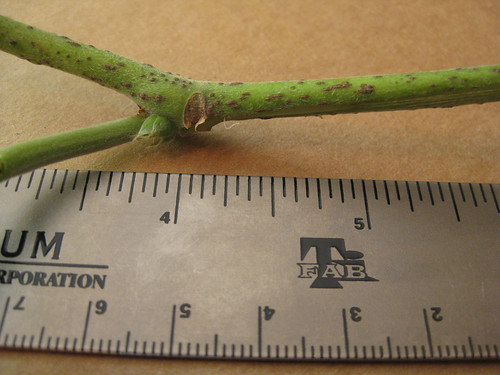
Stem: The stem is climbing or trailing, often covering other vegetation with its vines. The stems are green in color but develop red-brown spots as they age.

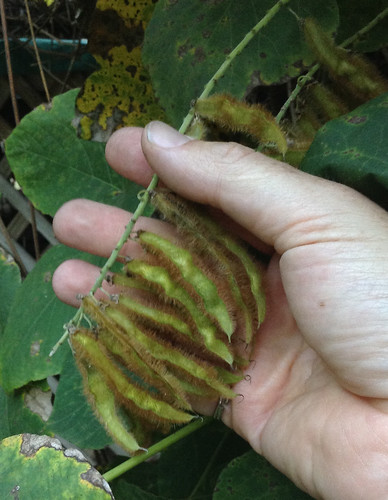
Hairs: Seed pods are very hairy, whereas stems and leaves may have extremely fine hairs.

Height: Kudzu is a fast-growing vine that can cover large areas, with vines reaching up to 100 feet in length.


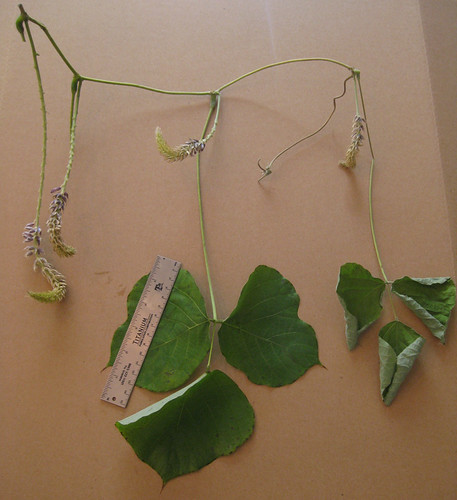
Kudzu vine.
Kudzu1

Kudzu2

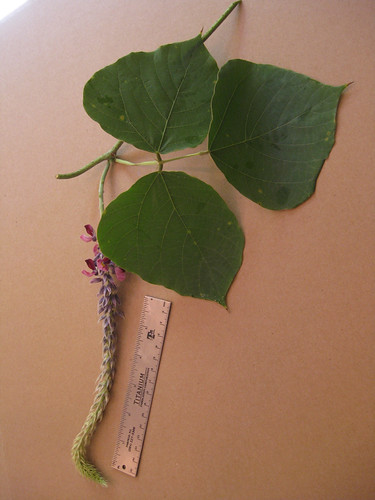
Close-up of kudzu leaves (three leaves per stem)
Kudzu3

Kudzu leaves in the wild look like Poison Ivy.
Kudzu

Close-up of open flowers.
Kudzu6

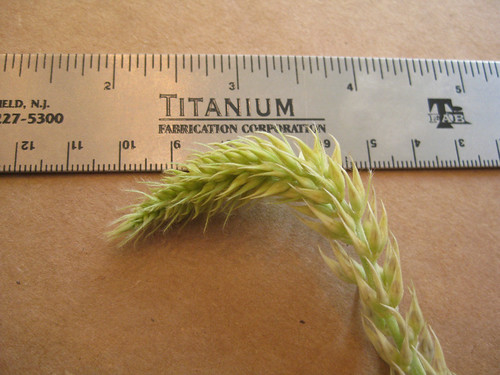
Close-up of closed flowers at tip of flower raceme.
Kudzu7

Close-up of vine stem.
Kudzu5

Kudzu seed pods are weirdly hairy.
Kudzu

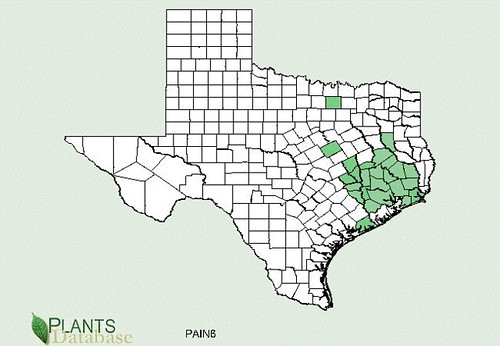
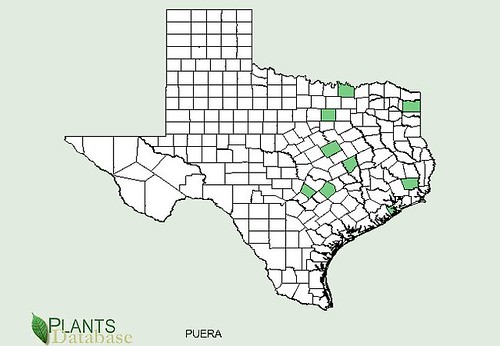
Texas distribution, attributed to U. S. Department of Agriculture. The marked counties are guidelines only. Plants may appear in other counties, especially if used in landscaping.
KudzuTX

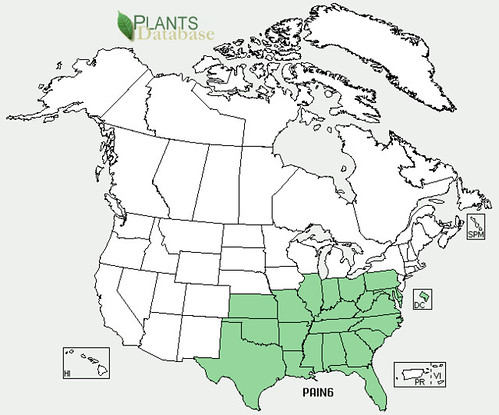
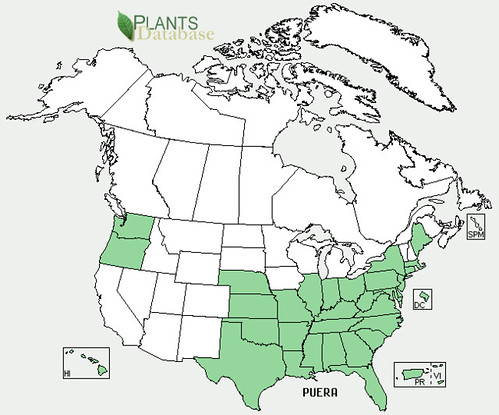
North American distribution, attributed to U. S. Department of Agriculture.
Kudzu

First introduced from Japan to the United States during the 1876 Centennial Exposition, this out-of-control weed now covers over seven million acres of the American South. Kudzu grows up to one foot per day, putting it in the top four fastest-growing plants known. As it grows it covers and smothers all other plant life...along with anything else that doesn't move out of its way. It is a common sight to see mile after mile of trees, powerlines, and abandoned homesteads covered in kudzu as you drive the backroads of the South.

It is small compensation that the kudzu can be eaten. It's vine tips are tender and full of important compounds such as antioxidants, as well as being high in protein (16% dry weight). The hairs on the vines and leaves make them unpleasant to eat raw, but a quick dip in boiling water wilts these hair so they no longer cause any problems. After boiling the vine tips and young leaves for 30-60 seconds they can then be used in any manner one would cook spinach, collard greens, or other leafy green vegetable.

Kudzu begins flowering in July and continues into September, producing an intense, somewhat artificial, grape smell. Open kudzu flowers can be used raw and make a colorful, flavorful addition to salads. They can also be seeped in hot water to make a tea. These flowers will last a day if kept in the refrigerator.

Kudzu roots can grow to enormous sizes, eight feet long and over 200 pounds! They contain a large percentage of starch but are also fibrous at that size. You are better off digging up smaller roots, 1.5" to 2.5" in diameter, which can be roasted like a potato. Be sure to peel the root before eating. The peeled roots can also be pounded, grated or ground into a gluten-free flour. The starch in kudzu roots can be fermented to produce alcohol. Woo hoo!! Roots are best dug up in the early fall but can be harvested all winter if you need the calories.

The seed pods are green in color and are not edible, nor are the seeds they contain.

Beware of poison ivy mixed in with kudzu. Please do not plant kudzu as it will escape your control and devour everything that doesn't move.


Buy my book! Outdoor Adventure Guides Foraging covers 70 of North America's tastiest and easy to find wild edibles shown with the same big pictures as here on the Foraging Texas website.


Identification and Treatment of Poison Ivy

Poison Ivy (Toxicodendron radicans)
Poison Ivy

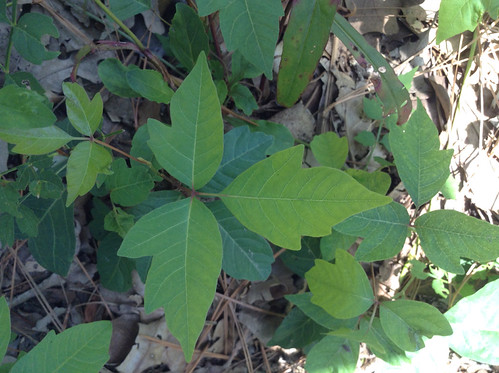
If you are a forager one of the first plants you need to be able to recognize is Poison Ivy...in all it's disguises. This is the true bane of those who wander the wild (and not so wild!) places. If you are allergic to the urushiol oil it produces this plant can cause havoc with you any time of the year. Time and again people suffer reactions internally from breathing the smoke from burning logs with a Poison Ivy vine attached. Due to the hard-to-remove properties of urushiol, clothes or pets that brushed against this terrible vine can cause a rash long after initial contact had occurred. Luckily, Poison Ivy has several distinctive features that make it easy to train your eye to spot it regardless of its attempts to hide!

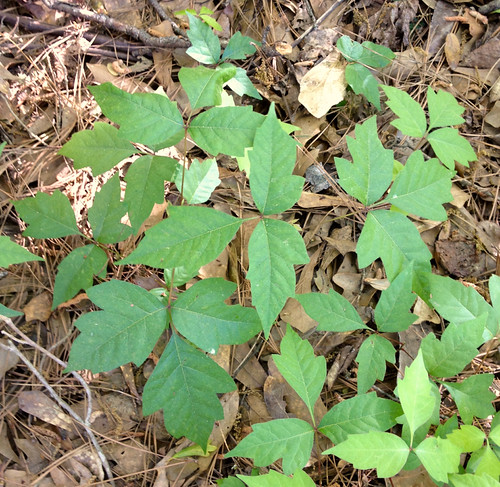
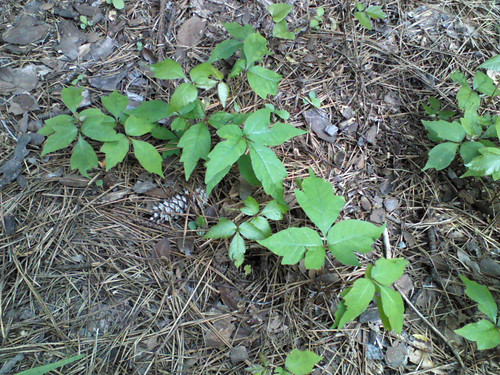
Let's start with something almost everyone has heard "Leaves of three, let it be!" Okay, sounds good but what does this actually mean? Well, every variation of Toxicodendron radicans will have compound leaves consisting of three leaflets. While there are non-dangerous plants with compound leaves having three leaflets it is good to be wary when first encountering such a plant until further observations can be made.

Poison Ivy

Looking at the pictures here notice that the center leaf is mostly (but not always perfectly) symmetrical, having very similar shape and area on either side of its center vein. However, the two side leaflets are asymmetrical with the side nearer the center leaflet being significantly thinner in area than the sides away from the center leaflet. The "away" sides will be much thicker and will usually have one or more lobes. Think of these side leaflets as being mitten-shaped with their thumbs pointing away form the center leaf.

These three leaflets can vary in "pointy-ness" ranging from almost like spearheads down to rounded ovals. In each case though the symmetrical/asymmetrical areas of the center/sides leaves will remain.

Poison Ivy

Another annoying thing that interferes with identification of poison ivy is that its leaves can vary in size from barely an inch across up to the size of dinner plates. If you are used to one size leaflet you may not spot a much bigger/smaller version until it's too late.

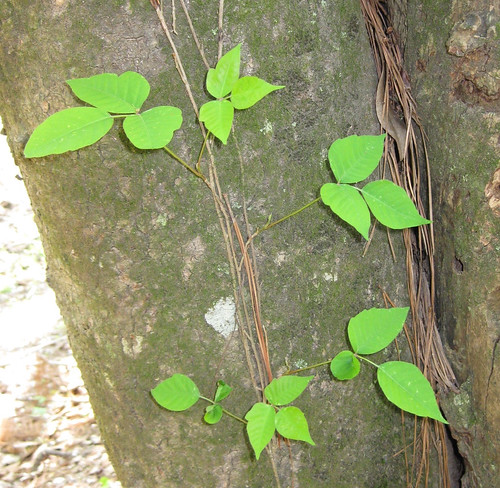
Now lets look at the plant in its entirety. It is a vine which can creep along the ground but prefers to climb up trees, fences, walls, or any other vertical surface it can grab. How does it grab the surface? Not using a few long tendrils like Grapes or Passionvine but rather with thousands of short hairs which hold the vines tightly against the tree/wall/old tractor/etc. In Texas (and other states of lesser importance) its always smart to avoid touching hairy vines tight against a surface. Many of these, even though not Poison Ivy, produce sap which can still cause irritation and rashes on bare skin.

Hairy vines = bad vines!
Poison Ivy

Poison Ivy creeping along the ground.
Poison Ivy

Since Poison Ivy is so good at protecting itself, it won't have any thorns. If you find a vine with thorns it won't extrude urushiol...but still pay close attention! Poison Ivy looks to climb the same trees as thorny vines such as Greenbriar, often even wrapping itself around the greenbriar vine itself. That sucks because greenbriar is delicious.

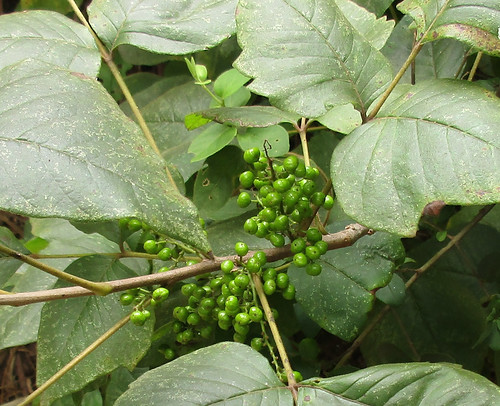
Poison Ivy flowers are green-yellow and appear in clusters. Soon they are replaced by small, green berries which turn white upon reaching maturity. The berries will have a small dot opposite their stem, making them look a bit like eyes. White berries are somewhat rare in the wild and so make a good warning that you've entered an area with Poison Ivy! Birds are unaffected by urushiol and love to feast on these plentiful fruit...thereby spreading Poison Ivy wherever they fly to.

Young, green berries before they turn white.
Poison Ivy

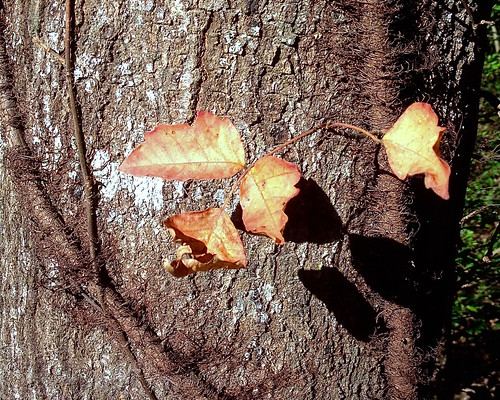
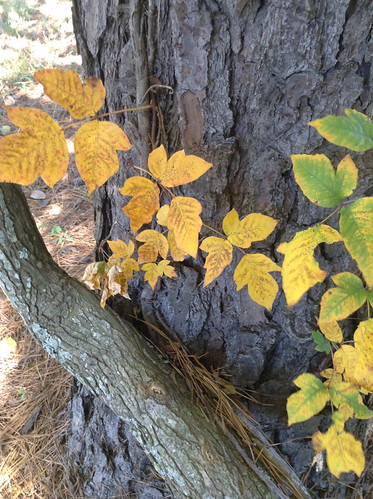
In the fall Poison Ivy leaves turn a beautiful red or yellow color, then brown before dropping from the vine. Once the leaves have dropped the hairy vines are easily seen clinging to tree trunks. Young vines will barely be thicker than a pencil lead whereas many-year old vines can be two inches thick or more.

Poison Ivy

Many people claim to be resistant to Poison Ivy's urushiol and that is quite likely. The rash is actually an allergic reaction rather than a specific chemical attack. However, like all allergies one can suddenly (and usually permanently!) develop an allergic response to Poison Ivy even after years of no effect. Doesn't that just suck?

Sometimes you'll hear of someone reversing their allergy to Poison Ivy by eating one of its leaves every day when they first appear in the spring. I have not tried this as it just sounds like a bad idea to me!

If you know you're going into an area heavy with Poison Ivy I strongly recommend coating your skin with Workman's Friend Skin Barrier Cream as prevention against the urushiol from coming in contact with your skin. Please note that this barrier cream only offers protection for about four hours and it doesn't protect your clothing from absorbing this nasty plant oil. Also in light of full disclosure, I currently work for the company that produces Workman's Friend Skin Barrier Cream

If you do accidentally touch Poison Ivy the best treatment I've found is the Tecnu product line, which whom I have no financial interest. Within the first eight hours of contact use Tecnu Original Poison Oak & Ivy Outdoor Skin Cleanser, ideally before any rash appears. If your skin is already blistering carefully use Tecnu Extreme Medicated Poison Ivy Scrub to remove any residual urushiol and help heal the rash.

If you didn't buy Tecnu in advance and no blisters have yet appeared you can try scrubbing very thoroughly with some sort of mechanics soap that's specifically designed to remove engine oil and grease. Supposedly this can be somewhat effective.


Buy my book! Outdoor Adventure Guides Foraging covers 70 of North America's tastiest and easy to find wild edibles shown with the same big pictures as here on the Foraging Texas website.
Groundnut

Scientific Name: Apios americana
Abundance: rare
What: tubers, flowers, vine tips, seedpods
How: tubers are boiled, roasted, not raw; flowers & yound seedpods cooked; vine tips raw or cooked
Where: moist areas
When: spring, summer, fall, winter
Nutritional Value: calories, protein
Dangers: 1% of the population is allergic to groundnuts

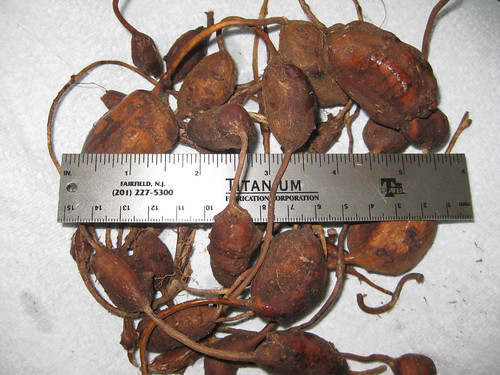
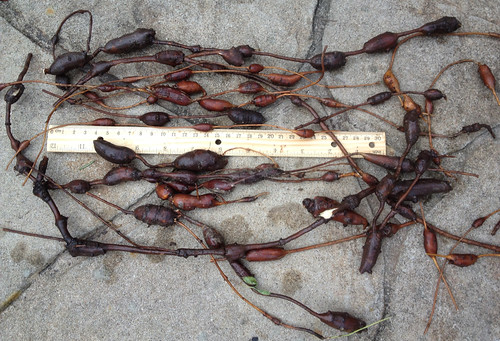
Groundnut tubers, 1-3 years old.
GroundnutTubers1

Groundnut

Groundnut vine.
GroundnutVine

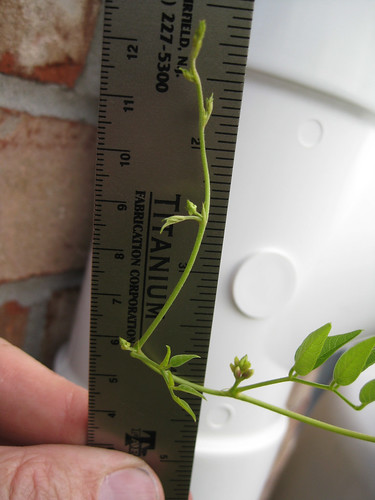
Close-up of groundnut vine tip.
GroundnutStemCU

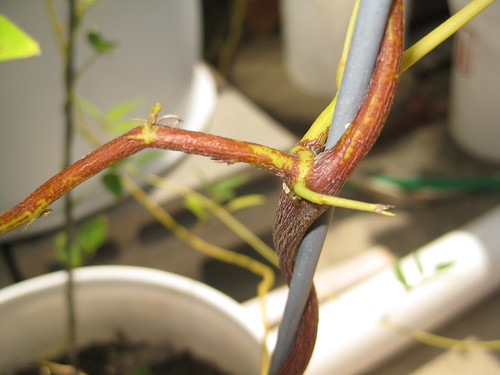
Close-up of groundnut stem.
GroundnutStem

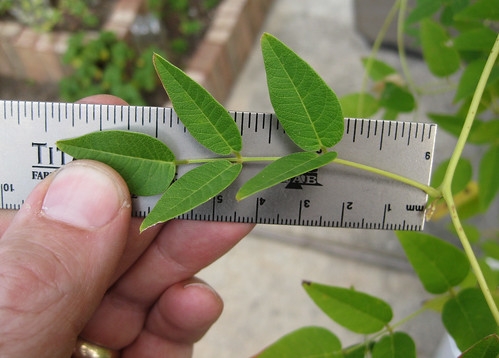
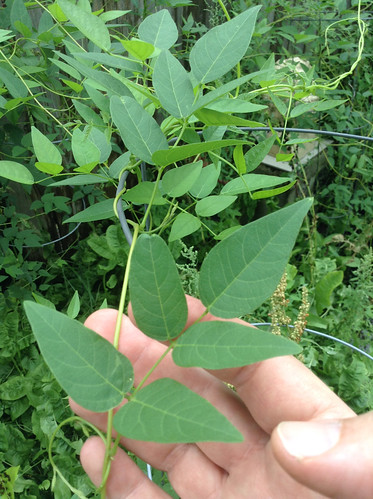
Groundnut leaf (odd-pinnate).
GroundnutLeaf1

Groundnut

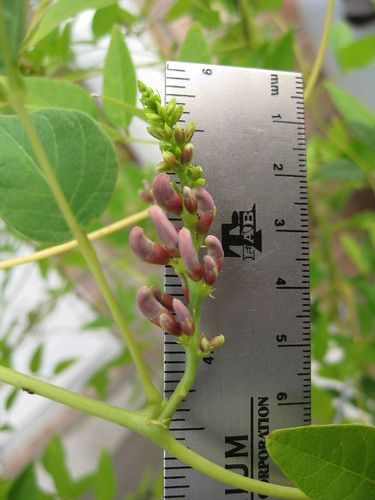
Close-up of unopened flowers.
GroundnutFlowers1

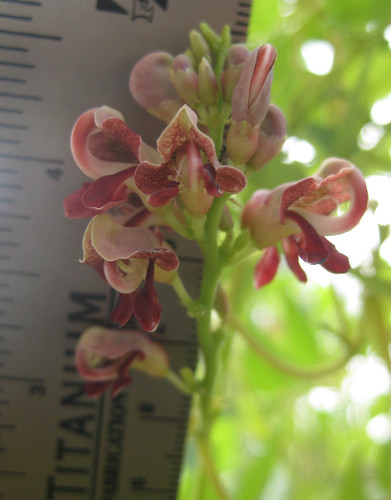
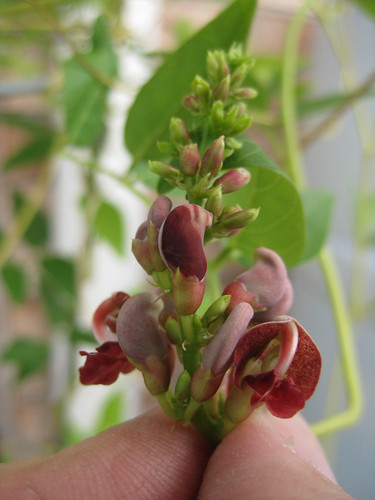
Close-up of opened groundnut flowers.
GroundnutFlower2

GroundnutFlower3

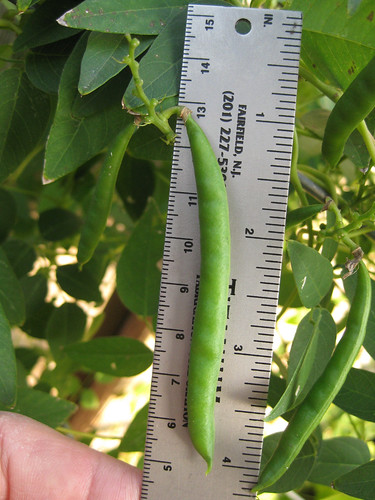
Groundnut seedpod. Cook before eating.
ApiosSeed

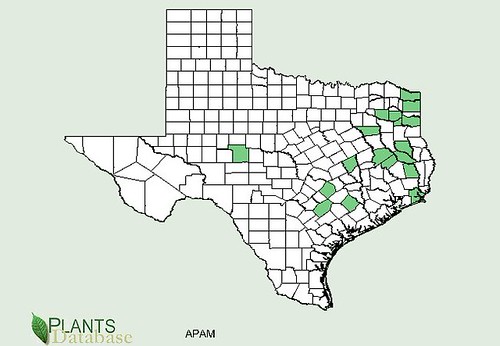
Texas distribution, attributed to U. S. Department of Agriculture. The marked counties are guidelines only. Plants may appear in other counties, especially if used in landscaping.
GroundnutTX

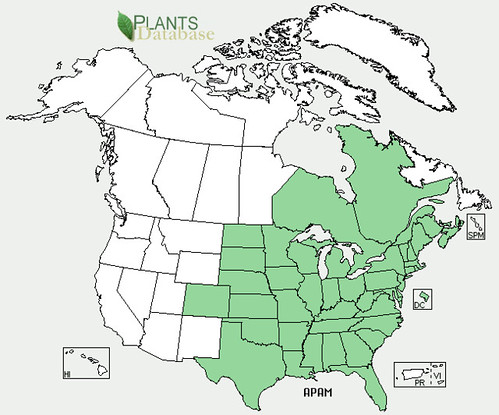
North American distribution, attributed to U. S. Department of Agriculture.
Groundnut

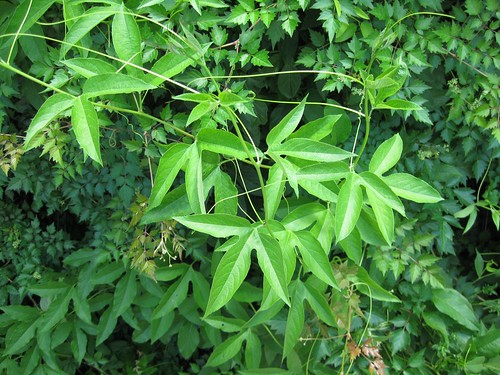
Groundnuts aka hopniss are a wonderful, potato-like tubers found in moist soils all across North America, including along many Texas streams and ponds. They like river banks, where their vines will entwine anything that will support them. These vines have a rough, hairy feel to them and range in color from reddish at the base up to pale green at the newest tips. The leave are odd-pinnate which means it's a compound leaf with and five to seven (always an odd number) leaflets off the main petiole (leafstem).The purple-white flower clusters appear in late summer and continue to appear into the fall.

The edible, slow-growing tubers can be dug any time of the year as they take up to three years to reach their full size, approximately as big as a hen's egg. The individual tubers will have their highest concentration of starch in the fall, which makes them tastiest at that time. These tubers grow in chains along the roots, once you find one you can follow the root to collect many more. An single vine can produce a dozen or more tubers, most of which will be big enough to eat.

These tubers can be prepared just like potatoes which frying being my personal favorite. They are a bit more bland as well as being a little bit fibrous than regular potatoes, but salt or other seasoning helps with the flavor. Groundnut tubers are significantly higher (up to 17% by weight) in protein than potatoes, which makes them an excellent food source.

The rest of the plant is edible but the flowers, bean-like seedpods, and vine tips aren't nearly as desirable as the tubers.

Groundnuts are easy to grow in your garden or a self-watering Earth Bucket as long as you have patience and plenty of water. I have them growing in both a wet spot in my yard and an Earth Bucket as part of my permaculture food forest.

While ground nut tubers are an amazing food, approximately 1% of the population can develop allergies to them. This allergy can hit the first time they eat the tubers or any time the sit down to a meal of them after that first time. There's no good way of telling in advance if a person might be allergic, but if someone has an extreme allergy to peanuts I would hesitate in giving them any part of the groundnut plant.


Buy my book! Outdoor Adventure Guides Foraging covers 70 of North America's tastiest and easy to find wild edibles shown with the same big pictures as here on the Foraging Texas website.
Privacy & Amazon Paid Promotion Statement

I use third-party advertising companies to serve ads when you visit this website. These companies may use information (not including your name, address, email address, or telephone number) about your visits to this and other websites in order to provide advertisements about goods and services of interest to you. If you would like more information about this practice and to know your choices about not having this information used by these companies, click here.

I participate in the Amazon Services LLC Associates Program, an affiliate advertising program designed to provide a means for me to earn fees by linking to Amazon.com and affiliated sites. The prices you pay for the item isn't affected, my sales commission comes out of Amazon's pocket.
*These statements have not been evaluated by the Food and Drug Administration. This product is not intended to diagnose, treat, cure, or prevent any disease.