Showing posts sorted by relevance for query landscaping. Sort by date Show all posts

Pyracantha

Scientific Name(s): Pyracantha genus
Abundance: plentiful
What: berries
How: raw, syrup, jelly, dehydrated fruit leather
Where: landscaping, woods
When: fall
Nutritional Value: vitamin C when raw or dehydrated
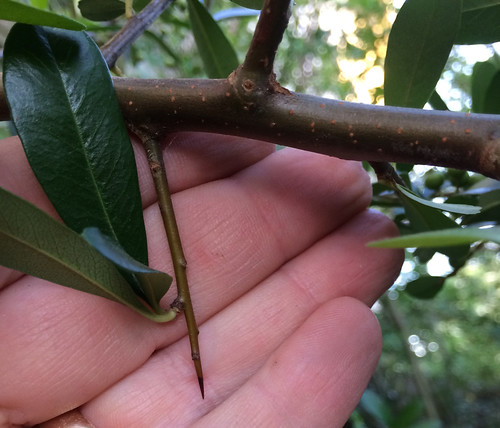
Dangers: thorns contain a natural, painful irritant

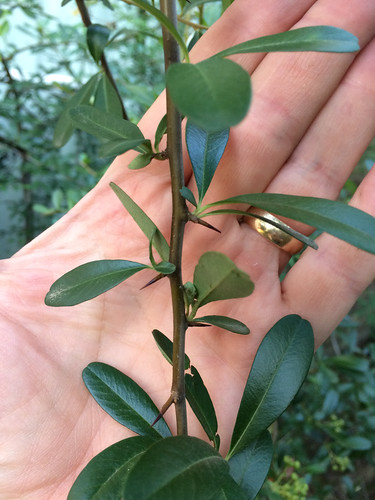
Leaf Arrangement: The leaves are arranged alternately along the stems.

Leaf Shape: The leaves are typically elliptical, with a length of 1 to 2 inches and a width of 0.5 to 1 inch.

Leaf Venation: The venation is pinnate.

Leaf Margin: The leaf margins are serrated, with sharp teeth along the edges.

Leaf Color: The leaves are usually dark green, and their color is uniform on both the upper and lower surfaces.

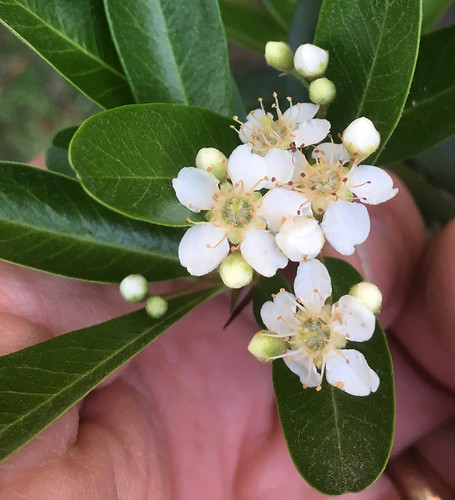
Flower Structure: The flowers are small and grouped in clusters called corymbs at the tips of the branches. Each flower has five petals.

Flower Color: Flower colors can vary but are commonly white, cream, or light pink.

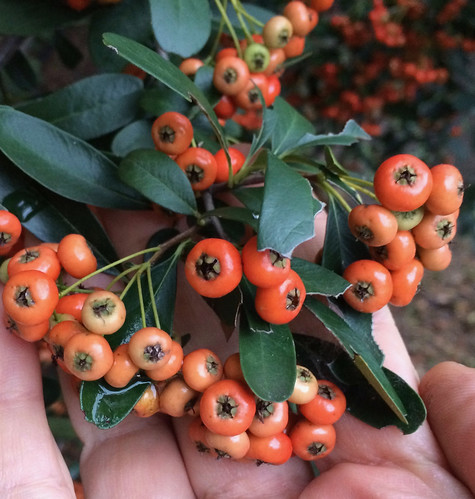
Fruit: The plant produces small, apple-like pomes/berries as fruit, usually in clusters.

Seed: The seeds are contained within the fleshy pomes.

Stem: The stems are woody and may have thorns or spines, depending on the variety.

Hairs: The plant may have fine hairs on the stems or leaves, contributing to a textured or slightly fuzzy appearance.

Height: Pyracantha species vary in height, ranging from 6 to 15 feet, forming dense, evergreen shrubs.
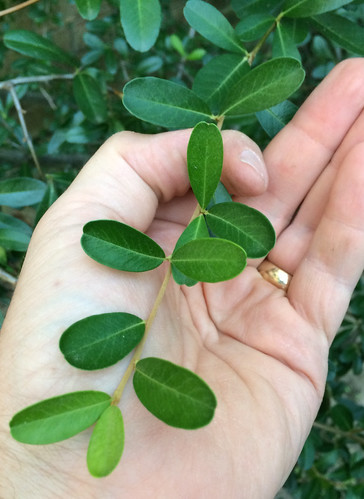

Leaves look like Yaupon holly leaves but Pyrancantha leaf edges are smooth whereas Yaupon holly leaf edges are bumpy.
Pyracantha

Leaves and thorns
Pyracantha

Thorn
Pyracantha

Close-up of flower
Pyracantha

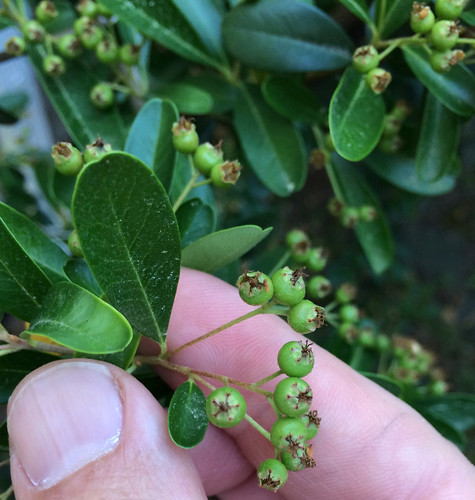
Unripe fruit, April in Houston. Note the "crowns" at the base of the fruit.
Pyracantha

Almost ripe, October in Houston.
Pyracantha

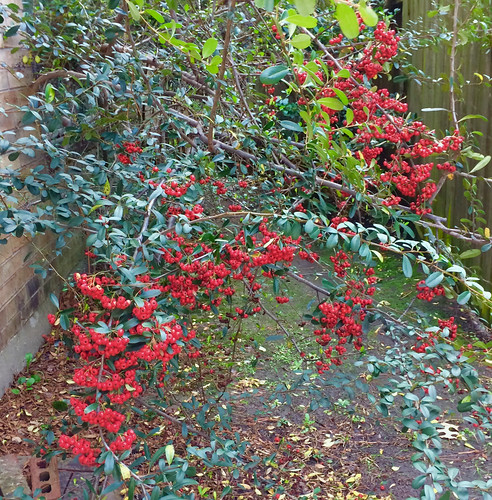
Fully ripe and ready to be made into jelly, January in Houston.
Pyracantha

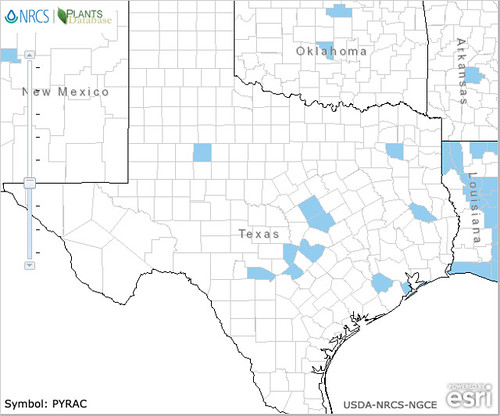
Texas distribution, attributed to U. S. Department of Agriculture. The marked counties are guidelines only. Plants may appear in other counties, especially if used in landscaping.
Pyracantha TX

North American distribution, attributed to U. S. Department of Agriculture.
Pyracantha NA

Fall brings forth a lot of different red berries in Texas, both wild and landscaping. One of the most thickly-covered red berry bushes is Pyracantha. These started out as a non-native landscaping plant but due to birds LOVING these berries, the seeds have been spread far and wide. Finding these thorn-covered bushes in the wild is becoming more and more common. The alternative name for these is "fire thorn" because the tips of its long, sharp thorns contain a powerful irritant, making any scratch from it hurt a lot more than expected.

Ripe, red Pyracantha (aka fire thorn) berries are a bland food but high in vitamin C. The most common use for these berries is to make jelly. Like with beautyberry, you need to add a lot more pectin to the syrup to get it jell up properly, up to doubling the amount pectin for a proper jelly. Some cinnamon improves the apple-like flavor. The end result will have lost a lot of its vitamin C due to the cooking process.

The best place to plant these evergreen shrubs is in front of large, first-floor windows. Their sharp, irritating thorns make an excellent barrier, sending thieves looking for an easier target. Food and protection in one plant! Prune it 1-2 times a year to shape the wall of thorns. If you're a birdwatcher, placement by a window will give you a front row seat as cedar waxwings and other birds show up to devour these berries.


Buy my book! Outdoor Adventure Guides Foraging covers 70 of North America's tastiest and easy to find wild edibles shown with the same big pictures as here on the Foraging Texas website.

Nanadina

Scientific Name(s): Nandina domestica
Abundance: invasive
What: berries, young leaves
How: boil leaves twice, berries made into jelly
Where: landscaping, woods
When: spring, summer, fall, winter
Nutritional Value: wood/roots contain berberine and
Dangers: seeds of berries are mildly toxic, leaves must be boiled twice before eating

Leaf Arrangement: The leaves are arranged alternately along the stems.

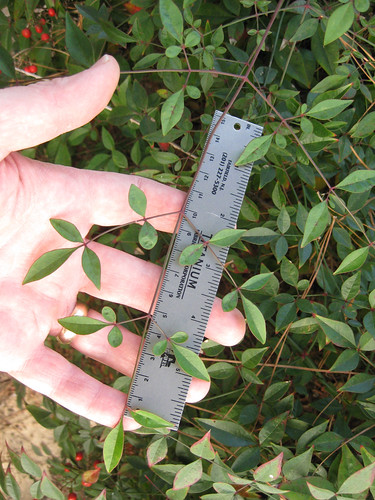
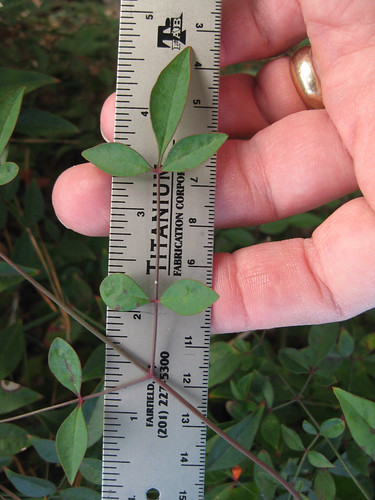
Leaf Shape: The leaves are pinnately compound, consisting of lance-shaped leaflets. Each leaflet can measure 1-2 inches in length and 1 inch in width. Leaflets are widely spaced along the leaf stem.

Leaf Venation: The venation is generally parallel in the individual leaflets.

Leaf Margin: The leaflets have serrated or finely toothed margins.

Leaf Color: The leaves are typically green, and in colder seasons, they can develop shades of red or bronze. The color may vary between the top and underside of the leaves.

Flower Structure: The flowers are arranged in large, terminal clusters (panicles) that can measure 8 to 12 inches in length.

Flower Color: The small, star-shaped flowers are white, and they form dense, showy clusters.

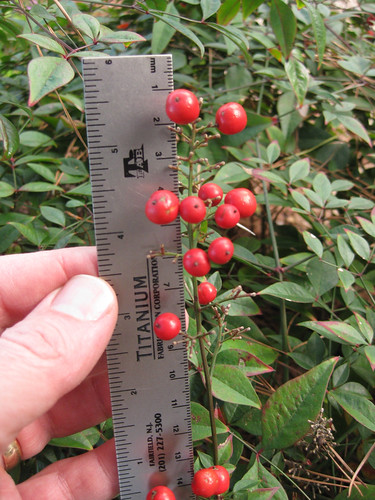
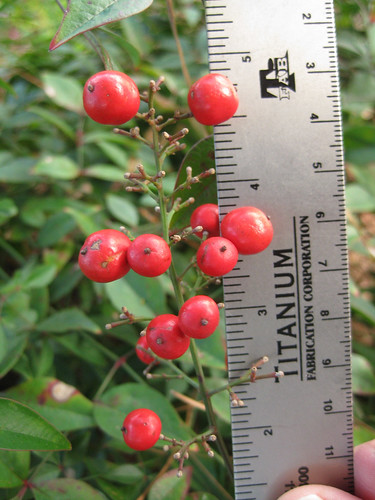
Fruit: The fruit is a bright red berry-like drupe, usually produced in clusters.

Seed: Each drupe contains a single seed.

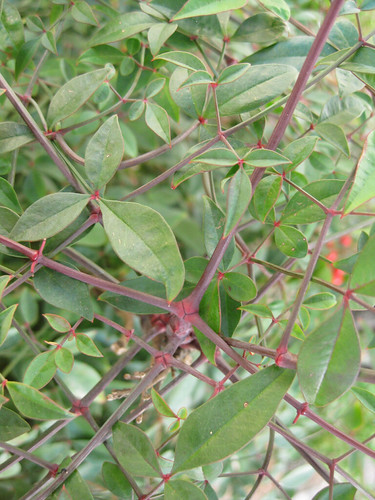
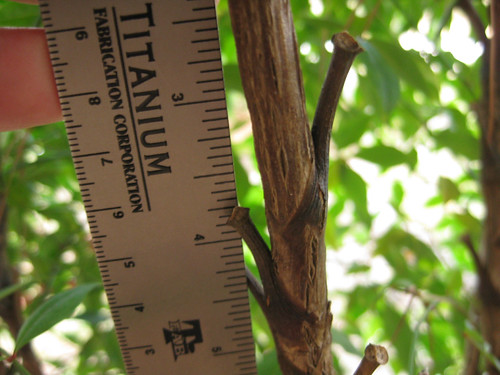
Stem: The stems are upright and woody, branching as they grow. Young branches may be reddish in color, old stems are brown and woody. Inner wood is yellow.

Hairs: The plant typically has smooth, hairless stems and leaves.

Height: Nandina domestica can reach a height of 4 to 8 feet, with a somewhat open and airy growth habit.


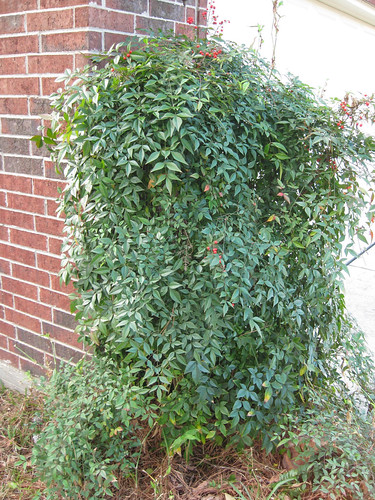
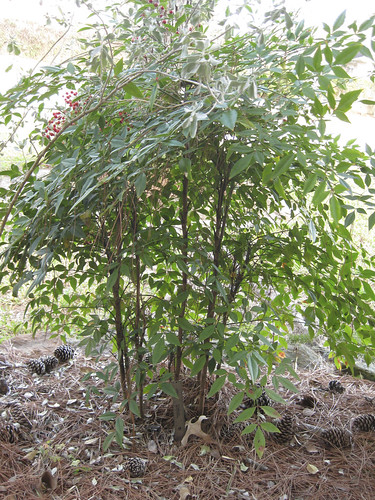
Nanadina aka "Heavenly Bamboo" is often used in landscaping but it has escaped into the wild.
Nandina5

Nandina8

Leaves are edible after boiling twice. Younger leaves are better than older ones.
Nandina3

Close-up of Nanadina leaf.
Nandina4

Younger portions of the plant stems have a reddish-purple color.
Nandina6

The pulp of Nanadina berries is edible but not overly flavorful. The seeds contain cyanide compounds and must be removed.
Nandina1

Nandian2

The woody trunks and older stems are peeled and whittled into flavorful toothpicks.
Nandina7

Texas distribution, attributed to U. S. Department of Agriculture. The marked counties are guidelines only. Plants may appear in other counties, especially if used in landscaping.
NanadinaUSDATX

North American distribution, attributed to U. S. Department of Agriculture.
NanadinaUSDANA

First arriving to the United States in 1804 AD, Nanadina has become a very common landscaping plant in warmer areas due to its evergreen leaves, attractive red berries, ability to thrive in sunny and shady areas as well as not being susceptible to pests or infections. Birds eat the berries...which has led to this plant showing up in many places it hadn't been planted. Nanadina is equally home in a suburban yard or deep Texas woods, both of which are far from its native Asian homeland.

Like Pokeweed, the leaves of Nanadina must be boiled twice before eating. This removes its toxic compounds as well as tenderizes the leaves. However, the end flavor isn't as pleasing as Pokeweed.

There's some debate on the edibility of the berry pulp but the berry seeds are known to be mildly poisonous due to containing cyanide compounds. The pulp has been used to make jelly but other fruits are usually included for improved flavor.

For those of you who like flavored toothpicks, the woody portions of this plant can be whittled into aromatic toothpicks and "chewing sticks".

The yellow roots contain berberine which is a powerful, broad spectrum antibiotic and also used to dye wool. It also contains higenamine which displays a number of medicinal effects.


Buy my book! Outdoor Adventure Guides Foraging covers 70 of North America's tastiest and easy to find wild edibles shown with the same big pictures as here on the Foraging Texas website.

Frog Fruit

Scientific Name(s): Lippia nodiflora
Abundance: common
What: leaves
How: cooked, tea, smoked
Where: yards, landscaping, fields, sunny,
When: spring, summer
Nutritional Value: vitamins
Dangers: beware of harvesting from soils treated with pesticides.

Medicinal Summary
Leaves - fever reducer, antimicrobial, cough suppressant, reduces respiratory issues (tisane, smoke)

Leaf Arrangement: Leaves are arranged in an opposite alternating pattern along the stem.

Leaf Shape: The leaves are broadly elliptical to ovate, typically measuring about 0.5 to 1.5 inches in length and 0.25 to 0.75 inches in width.

Leaf Venation: Venation is pinnate, with a central vein and smaller veins branching off towards the margins.

Leaf Margin: The margins are serrated or toothed, particularly towards the leaf tip.

Leaf Color: The color of the leaves is a deep green, often with a slightly lighter shade along the veins.

Flower Structure: Flowers are small, clustered in dense, rounded heads at the tips of stems or in leaf axils, and have a funnel shape.

Flower Color: The flowers are usually white or pale pink.

Fruit: The fruit is a small, dry, two-part capsule.

Seed: Seeds are tiny, contained within the small capsules.

Stem: Stems are slender, creeping or trailing, and can root at the nodes.

Hairs: There are fine hairs along the stems and leaves.

Height: The plant typically spreads along the ground, with the flowering stems rising a few inches above the foliage.

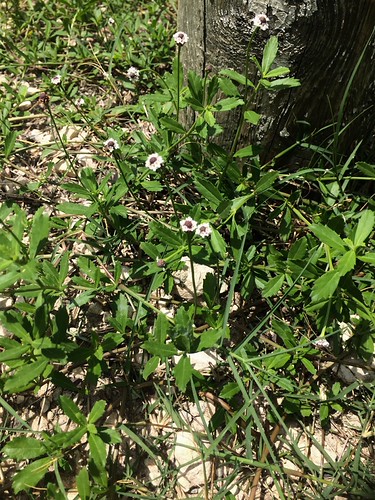
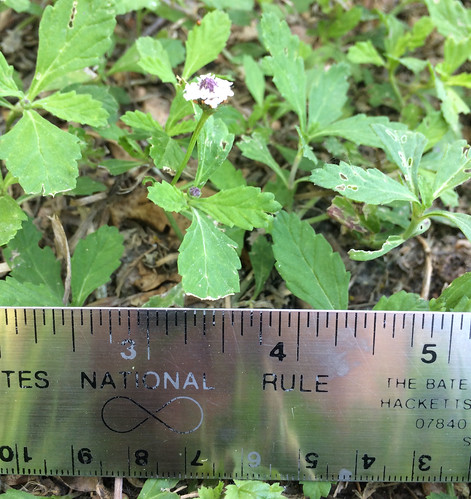
Lots of frog fruit.
Frog Fruit

Frog Fruit

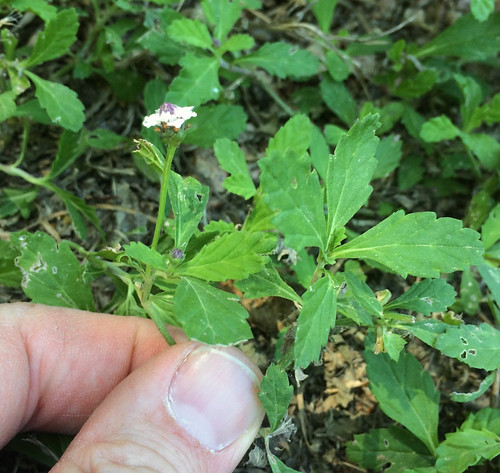
Frog fruit leaves.
Frog Fruit

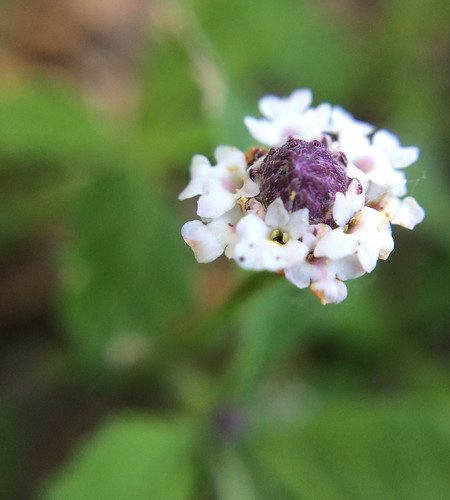
Close-up of frog fruit's flower cluster.
Frog Fruit

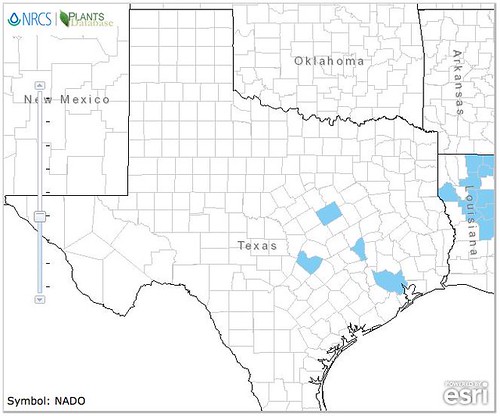
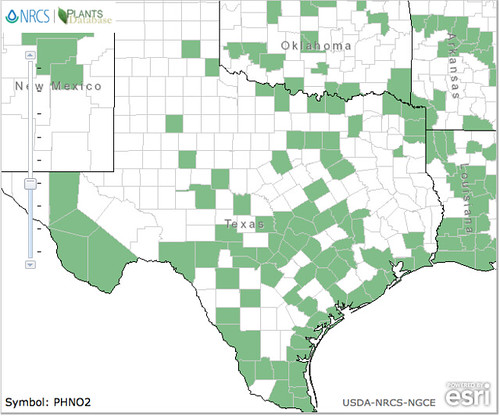
Texas distribution, attributed to U. S. Department of Agriculture. The marked counties are guidelines only. Plants may appear in other counties, especially if used in landscaping.
FrogFruit TX USDA


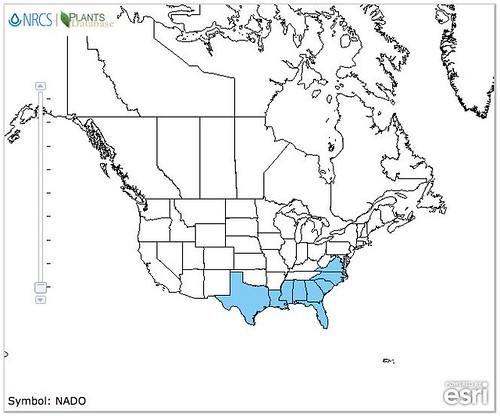
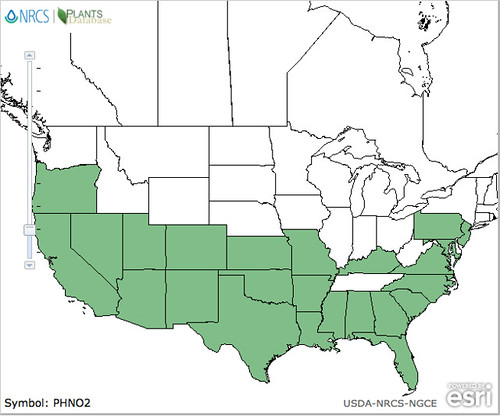
North American distribution, attributed to U. S. Department of Agriculture.
FROGFRUIT NA USDA


I really don't know why frog fruit has this name, though the flower clusters do look kind of like tiny pineapples. This common, summertime weed seems to like sunny, grassy areas and disturbed locations. In these places it can form thick mats, shot through with a few other low weeds and grasses. Its tough leaves have pointy-toothed edges and a pinnate vein pattern. Stems are tough and somewhat rough. Because of its durable, drought resistant nature it is becoming popular in landscaping.

While the cooked leaves are edible, their texture and grass-like flavor isn't all that great. A more common use is to make a tea or smoked. Used in these manners, frog fruit is believed to offer relief from fevers, coughs, and other mild respiratory issues. For tea and smoking, let the leaves dry for a few weeks for best flavor and medicinal properties.


Buy my book! Outdoor Adventure Guides Foraging covers 70 of North America's tastiest and easy to find wild edibles shown with the same big pictures as here on the Foraging Texas website.

Chaste Tree


Scientific Name(s): Vitex agnus-castus L.
Abundance: common
What: seeds
How: ground for seasoning
Where: landscaping
When: fall, winter
Nutritional Value: none
Dangers: supposedly lowers libido in men while also makes women more likely to get pregnant

Medicinal Summary:
Dried Seeds* - maintains proper progesterone/prolactin levels; reduces excess prolactin; soothes PMS breast tenderness; reduces heavy menstrual bleeding; reduces cycles longer than 28-days; increase milk production; may prevent uterine fibroids; mild sedative; reduces PMS and menopause mood swings; which helps with PMS mood swings; reduces menopause hot flashes (tincture, tisane)
*can reduce male libido over time

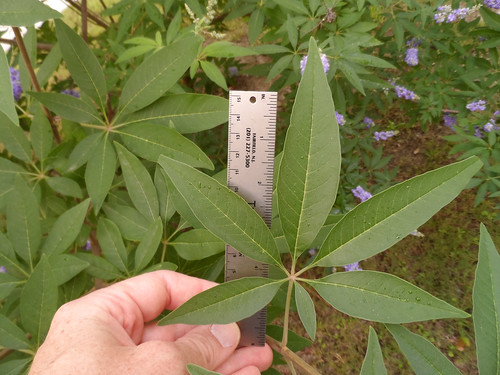
Leaf Arrangement: Leaves are opposite, arranged in pairs along the stem.

Leaf Shape: Palmately compound leaves with typically 5 to 7 leaflets, each leaflet measuring around 2 to 4 inches in length.

Leaf Color: Foliage is typically gray-green.

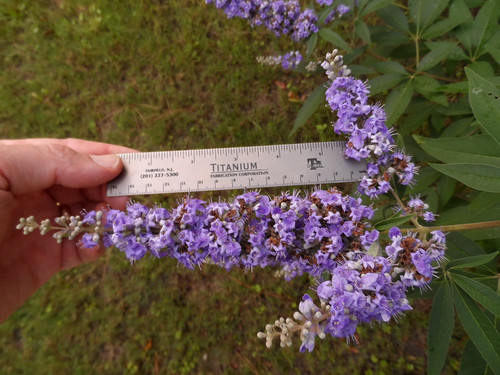
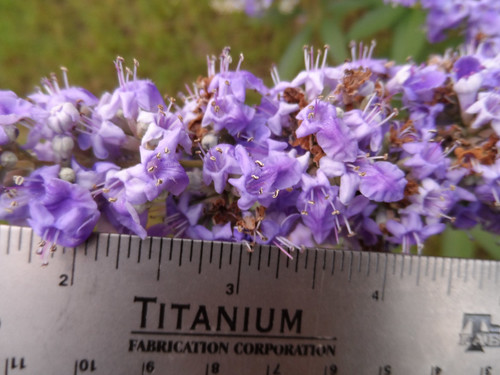
Flower Structure: Chaste tree produces spikes of small, fragrant flowers. The spikes can reach lengths of 6 to 12 inches.

Flower Color: Flowers come in various shades, including lavender, blue, pink, or white.

Fruit (Seed): The fruit is a small, round drupe, approximately 0.2 to 0.3 inches in diameter.

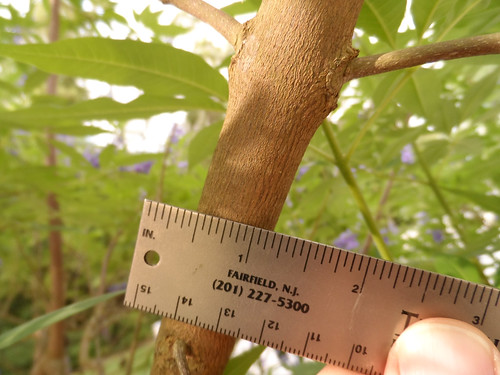
Bark: The bark is typically smooth and gray-brown.

Height: Chaste trees can grow to be 10 to 20 feet tall.

Hairs: Leaves and stems are generally smooth, but fine hairs may be present on the undersides of leaves.

Branching Pattern: Chaste trees have an open, spreading habit.

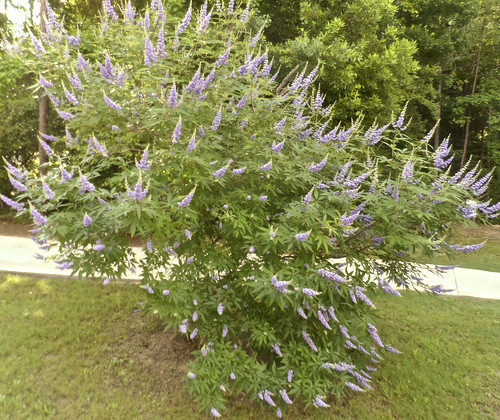
Chaste Tree
ChasteTree1

Chaste Tree leaves (not edible).
ChasteTreeLeaf1

Chaste Tree flowers (not edible).
ChasteTreeFlower1

Chaste Tree flowers close-up.
ChasteTreeFlower2

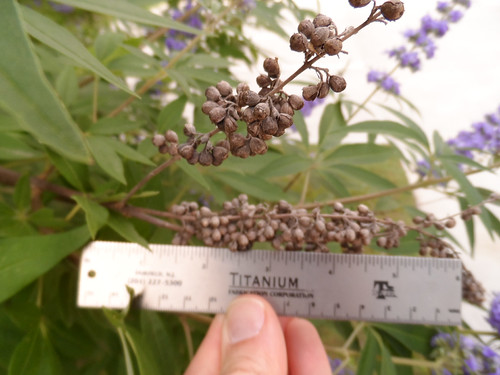
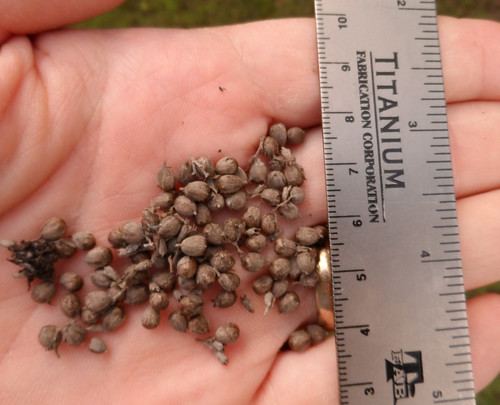
Chaste Tree seeds (edible).
ChasteTreeSeeds1

ChasteTreeSeeds2

Chaste Tree bark.
ChasteTreeBark1

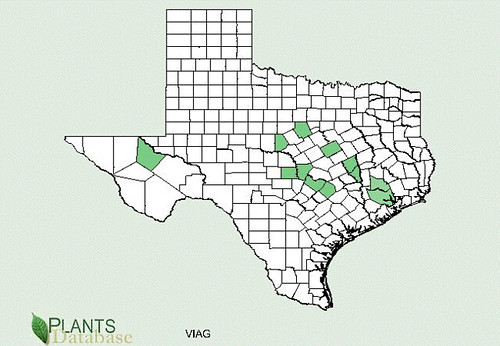
Texas distribution, attributed to U. S. Department of Agriculture. The marked counties are guidelines only. Plants may appear in other counties, especially if used in landscaping.
ChasteTreeTX
This map is very incomplete.

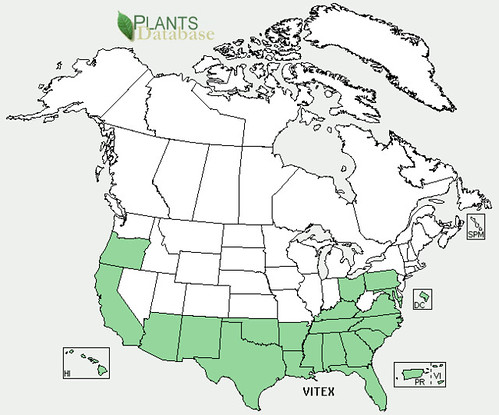
North American distribution, attributed to U. S. Department of Agriculture.
ChasteTree

With summer comes the multitude of blue, flowering spikes of the Chaste Tree. Used in landscaping all across the south, this multi-trunked small tree/large bush is cherished for it's beauty, scent, and attraction for bees, hummingbirds, and butterflies. Rarely if ever is tree found in the wild and if so it will be in full sun to partial shade with well drained soil. Besides almost every branch ending in a large spike of small flowers, the leaves of the Chaste Tree are sometimes mistaken for those of the marijuana plant.

In fall the flowers have become small gray/brown seeds which, when crushed release a pungent but pleasant aroma and flavor. For this reason the seeds have been used as a seasoning for ages. However, there is a belief that the seeds, when consumed, reduce a man's desire hence the name "chaste". Monks supposedly used Chaste Tree seeds to season their food and also reduce their passions. Chaste Tree seeds, in small doses, can slightly increase the amount of female hormone prolactin in men, which may give rise to the...uh, failure to rise. However, larger doses can actually reduce prolactin in men, perhaps making them more manly.

There is quite a bit of evidence and scientific studies which show these seeds have a great deal of beneficial effects for women. There is proof these seeds help with PMS, and many other menstrual issues, helping fertilized eggs bond to the womb, and many other hormone-based issues. Please note, this is not medical advice, just a review of what others claim.


Buy my book! Outdoor Adventure Guides Foraging covers 70 of North America's tastiest and easy to find wild edibles shown with the same big pictures as here on the Foraging Texas website.

Sweet Potato

Scientific Name(s): Ipomoea batatas
Abundance: common
What: leaves, tubers
How: Leaves raw, boiled then sautéed; tubers boiled, roasted
Where: landscaping
When: summer, fall
Nutritional Value: calories, fiber, protein, vitamins C,B6, riboflavin, thiamin and niacin, minerals K, P, Ca, Mg, Fe, Mn, and Cu

Leaf Arrangement: Leaves are alternately arranged along the stems.

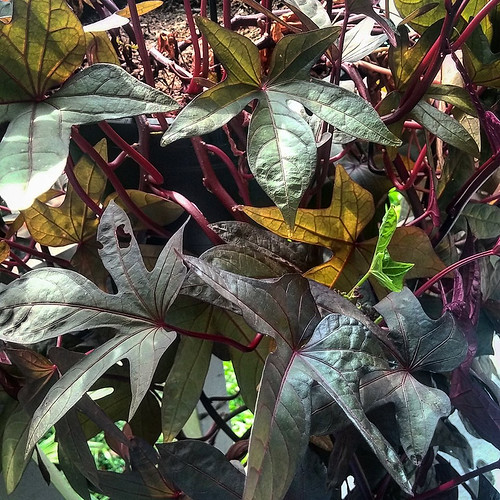
Leaf Shape: Leaves are variable, ranging from heart-shaped to palmately lobed or entire, typically measuring 2 to 6 inches in width and length.

Leaf Venation: Venation is palmate, with a multiple veins running from base of leaf out to its edges and lobe tips. 

Leaf Margin: Margins can be entire, lobed, or wavy, depending on the variety.

Leaf Color: Ranges from green to purple or reddish, sometimes variegated.

Flower Structure: Flowers are funnel-shaped, borne on short stalks, and typically 1.5 to 3 inches in diameter.

Flower Color: Usually pink, purple, or white.

Fruit: Produces a capsule containing 4 black seeds.

Seed: Seeds are small, black, and angular, about 0.1 inches in diameter.

Stem: Stems are long, slender, and vining, often rooting at the nodes.

Hairs: Stems and leaves can be smooth or sparsely hairy.

Height: The plant is generally sprawling, with vines extending several feet in length.


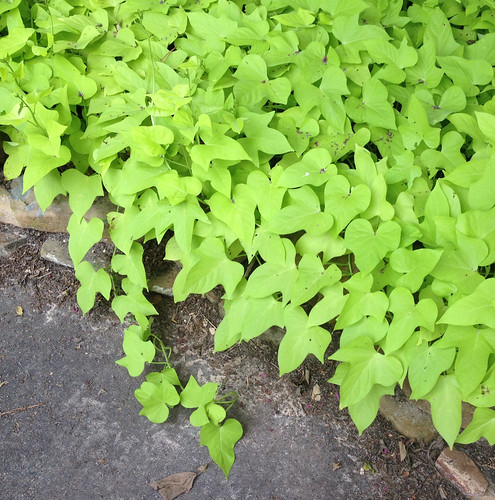
Sweet Potato vine.
Sweet Potato

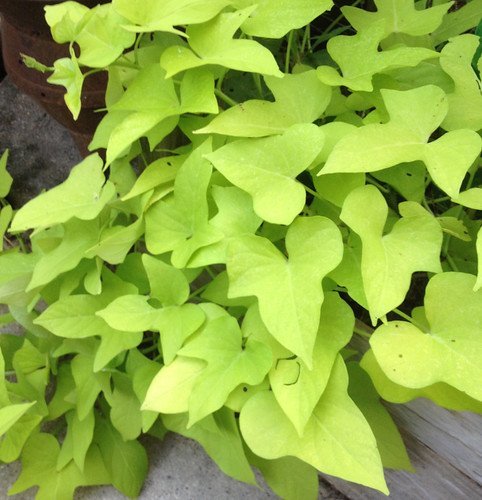
Close-up of Sweet Potato leaves.
Sweet Potato

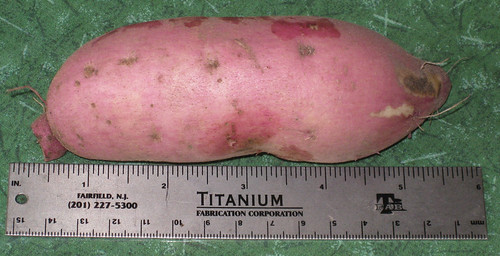
Sweet Potato tubers.
Sweet Potato

Sweet Potato

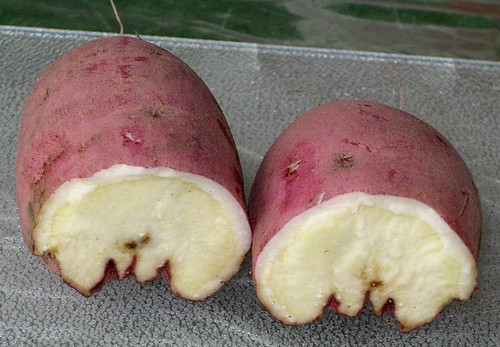
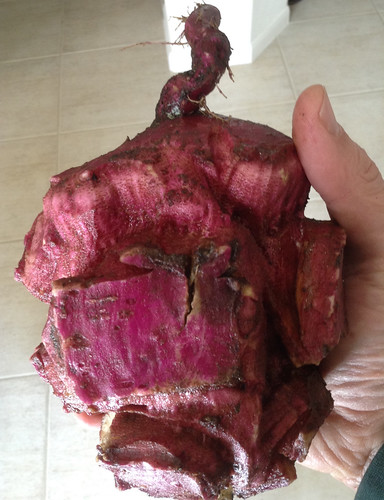
Sweet Potato tuber cut open, note they are not orange.
Sweet Potato

Purple Sweet Potato vines are the most nutritious of the different varieties.
Sweet Potato
Picture contributed by Eric Cee of SPEAR Survival.

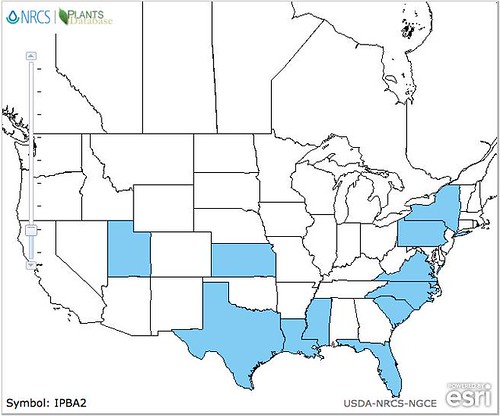
North American distribution, attributed to U. S. Department of Agriculture.
SweetPotato-NA

Few plants seem to thrive in the Texas summer heat like Sweet Potatoes. There prolific, yellow-green vines explode in late June and on until cold fall weather (if any) appears. In a sheltered spot they can ever survive all year long in Houston and locations farther south. This durability, low water requirements, and resistance to the sun's burning rays make them an extremely popular, low-cost landscaping plant...resulting in highly nutritious food all over the place!

While the young, tender leaves can be eaten raw in salads and on sandwiches, most people prefer to make them more tender with a quick boil, followed by sautéing them in butter with onions, garlic, or other herbs. Think of the leaves as another spinach substitute, though Sweet Potato leaves don't shrink up nearly as much as spinach.

The tubers of decorative Sweet Potatoes lack the huge quantity of vitamin A (and its resultant orange color) found in Sweet Potatoes raised specifically as food. The fluctuations in available water cause these pale, though mineral and calorie rich, tubers to grow in spurts, usually resulting in cracked surfaces. While these fissures make cleaning and peeling the tubers somewhat difficult, they don't affect the flavor. Note though, the flavor will be somewhat "rougher" and less sweet than the Sweet Potatoes you are used to.

The number of tubers per plant is much less than one normally finds with the food crop version but considering how many plants there are of this, if one falls the fall landscaping crew digging up these vines and replacing them with winter plants, you easily gather your fill! Also note, like regular potatoes, these tubers can be used to make alcohol. Woohoo!


Buy my book! Outdoor Adventure Guides Foraging covers 70 of North America's tastiest and easy to find wild edibles shown with the same big pictures as here on the Foraging Texas website.

Prairie Verbena

Scientific Name(s): Glandularia bipinnatifida
Abundance: common
What: roots, stems, leaves, flowers
How: tincture, tea (tisane)
Where: sunny fields, disturbed areas, landscaping
When: spring, summer, fall
Nutritional Value: unknown
Dangers: do not take if pregnant

Medicinal Summary: nervine (anti-anxiety), mild sedative, anti-inflammatory

Leaf Arrangement: The leaves are opposite-alternating, meaning pairs of leaves grow at the same level on opposite sides of the stem and the set above below will be rotated 90 degrees along the stem.

Leaf Shape: The leaves are deeply divided and bipinnatifid (leaf clefts have smaller clefts), measuring approximately 2-4 inches in length and 1-2 inches in width.

Leaf Venation: The leaves have pinnate venation, with a central midrib from which smaller veins branch out laterally.

Leaf Margin: The margins of the leaves are serrated with deep, irregular lobes.

Leaf Color: The leaves are green, typically a bright to medium green shade.

Flower Structure: The flowers are tubular and arranged in dense, rounded clusters called corymbs, located at the ends of stems. Individual flowers measure about 0.2-0.4 inches in diameter. Each of the five petals has a rounded notch at the outer end.

Flower Color: The flowers range from pink to purple, often with variations in hue within the same cluster.

Fruit: The fruit is a schizocarp (husked seed pod) that splits into four nutlets, each about 0.1 inches long.

Seed: Each nutlet contains a single seed, approximately 0.1 inches in length and 0.05 inches in width.

Stem: The square stems are erect and hairy, with a diameter of around 0.1-0.2 inches. They may become woody as the plant ages, especially near the base.

Hairs: The plant has glandular hairs that excrete a sticky substance, especially noticeable on stems and leaves.

Height: The plant typically reaches a height of 6-24 inches, depending on growing conditions.


Prairie Verbena Glandularia bipinnatifida

Prairie Verbena Glandularia bipinnatifida

Prairie Verbena Glandularia bipinnatifida

Prairie Verbena Glandularia bipinnatifida

Prairie Verbena Glandularia bipinnatifida

Texas distribution, attributed to U. S. Department of Agriculture. The marked counties are guidelines only. Plants may appear in other counties, especially if used in landscaping.


North American distribution, attributed to U. S. Department of Agriculture.


Prairie verbena aka Dakota Mock Verbena is (sadly) always a big hit in my foraging classes. Why is this depressing? Because often up to 80% of the students get really excited to learn it has anti-anxiety powers. Why the heck are so many people suffering from anxiety?! I don't get it, but at least nature is there to help.

To access its mentally soothing powers, pour 10oz of boiling water over one teaspoon of dried plant matter (flowers, leaves, & stems), then let steep 5-8 minutes. Strain out the verbena material, let cool to a drinkable temperature, then drink. The flavor can be adjusted with lemon and/or honey if desired.

Verbenas are not safe for pregnant women as they can stimulate uterine contractions.

These flowers are easily added to landscaping, bringing a long-lasting touch of color. They thrive in full sun all across Texas and surrounding states. While maybe not as strong of anti-anxiety agent as passion vine, it doesn't spread and take over your yard like Passafloria vines do.


Privacy & Amazon Paid Promotion Statement

I use third-party advertising companies to serve ads when you visit this website. These companies may use information (not including your name, address, email address, or telephone number) about your visits to this and other websites in order to provide advertisements about goods and services of interest to you. If you would like more information about this practice and to know your choices about not having this information used by these companies, click here.

I participate in the Amazon Services LLC Associates Program, an affiliate advertising program designed to provide a means for me to earn fees by linking to Amazon.com and affiliated sites. The prices you pay for the item isn't affected, my sales commission comes out of Amazon's pocket.

*These statements have not been evaluated by the Food and Drug Administration. This product is not intended to diagnose, treat, cure, or prevent any disease.